
A mid-market retail group in London signs off on its first India capability centre. On paper, everything about the launch goes right. The board approves a lean, phased plan. A setup partner handles the mechanics with impressive polish: the entity is registered in eight weeks, an Employer of Record takes care of payroll, provident fund and statutory compliance from day one, and a Grade-A office in Bengaluru is fitted out before the first cohort arrives. By month three there are thirty engineers at their desks. Every metric on the launch dashboard is green — time-to-hire, seats filled, cost per full-time employee, all comfortably ahead of plan.
Six months later, the mood in London has quietly soured. Work is flowing to Bengaluru, but it is the wrong work. Tickets, bug fixes, test coverage, and the overflow tasks the senior HQ engineers were glad to be rid of. The interesting problems — the architecture calls, the roadmap decisions, the difficult customer-facing features — somehow never make the trip. The HQ engineering lead keeps “just handling the tricky bits himself.” The India lead, hired as a senior architect, spends her days triaging a queue. At the quarterly review, utilisation is high and the cost line looks excellent, yet nobody in the room can name a single outcome the centre actually owns.
Here is the uncomfortable part: nobody made a mistake. The setup was flawless. That is precisely the problem. They bought a launch when what they needed was an operating model — and the two are not the same thing. One gets you thirty people at desks in India. The other decides whether those thirty people become a genuine capability or an expensive execution arm that slowly bleeds its best talent.
The setup problem is solved. That is the problem.
This is the untold half of India’s capability-centre boom. The headline numbers are genuinely staggering. India now hosts 2,117 GCCs across 3,728 units, generating roughly $98.4 billion in revenue and employing 2.36 million professionals, according to the FY26 Nasscom–Zinnov landscape — a market on course for around $105 billion and 2,400 centres by 2030. For most of the past two decades this was a Fortune 500 story: only the largest global enterprises could justify tens of millions of dollars to build a managed delivery hub in Bengaluru or Hyderabad. That story has changed. Today, 583 of India’s capability centres are mid-market, and the segment is the fastest-growing in the entire ecosystem.
The reason mid-market has arrived is that the cost and risk of starting have collapsed. A decade ago, standing up an entity, leasing space, building compliance infrastructure and hiring a leadership team demanded a minimum viable investment of $3–5 million — an outlay that only made sense at scale. Phased operating models changed the arithmetic. A company can now begin with a handful of senior engineers hosted through an Employer of Record, transition to a Build-Operate-Transfer arrangement once the model is proven, and convert to a wholly owned captive only when the numbers justify it. Managed setup services and coworking-ready Grade-A space have pushed the minimum viable investment down to somewhere between $500,000 and $2 million, with break-even achievable at 25–50 engineers.
Policy has pushed in the same direction. India’s Union Budget 2026 set a uniform 15.5% safe-harbour margin for transfer pricing and raised the qualifying threshold to ₹2,000 crore, giving first-time entrants far more tax certainty than existed even three years ago. Full foreign direct investment remains permitted under the automatic route for IT services and most GCC-relevant sectors, requiring no prior government approval. In short, almost every friction that once made a capability centre a big-company privilege has been engineered away.
And that is exactly why setting one up is no longer what separates the winners from the also-rans. When a capability becomes cheap and easy to acquire, it stops being a differentiator — everyone can have it. The differentiation moves downstream, to what happens after go-live. The centres that will matter in five years will not be distinguished by how quickly they launched or how little they cost to stand up. They will be distinguished by how well they were designed to operate.
A capability centre that only ever takes orders isn’t a capability centre. It’s a support desk in a different time zone.
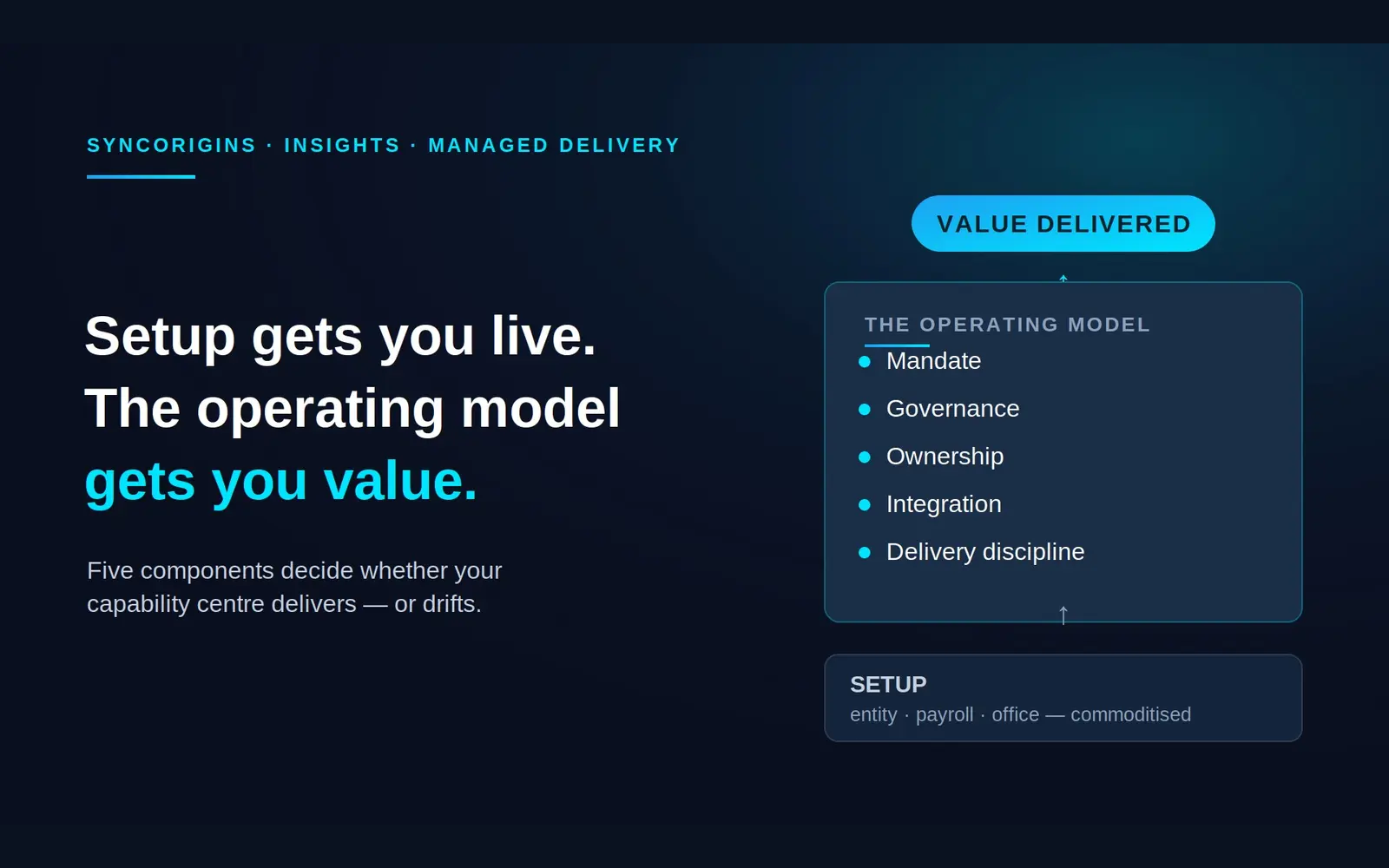
| • | Mandate. This is the single most important decision, and the one most often made by default. A mandate defines which outcomes the centre genuinely owns, as opposed to which work merely passes through it. Decided deliberately, it might read “own the mobile checkout experience end to end.” Left to drift, it always resolves to the same thing: overflow — whatever HQ does not want to do that week. |
|---|---|
| • | Governance. A capability centre operates across a five-to-ten-hour time gap, which means the informal coordination that holds a co-located team together simply does not exist. Governance is the deliberate replacement: how priorities are set, how quality is assured, how issues escalate, and — critically — who is accountable when delivery slips. Without it, the centre defaults to whoever shouts loudest across the time zone. |
| • | Ownership design. There is a world of difference between a team that owns a product and a roadmap and a team that closes tasks from a queue. Ownership is what attracts and retains senior engineers; a task queue is what drives them out. In a market where GCC roles now out-pay both domestic IT services and traditional multinational jobs, the centres that offer real ownership win the talent, and the ones that do not churn through it. |
| • | Integration. The most common long-term failure mode for a capability centre is cultural, not operational. The moment the India team starts to feel like a vendor rather than a colleague, engagement drops and attrition climbs. Integration is the deliberate work that prevents it: shared OKRs, rotational contact with HQ, inclusion in global planning, and peer-level relationships rather than a strict client–supplier dynamic. |
| • | Delivery discipline. Underneath all of it sits the managed-delivery layer: the service levels, throughput expectations, and accountability that turn intent into shipped work. This is the difference between a centre that is merely busy and a centre that delivers — and it is the layer that quietly hands the hard problems back when it is missing. |
Why the people who sold you the centre won’t fix this
If the operating model matters this much, why does almost none of the widely-read guidance address it? Follow the incentives. The overwhelming majority of GCC content is produced by setup vendors — real-estate firms, Employer-of-Record providers, and “GCC-as-a-service” partners — and their commercial model rewards exactly one outcome: getting you operational. That is the moment they are paid, and for many of them the engagement tapers off shortly afterwards. Their success metric is “centre live,” not “centre delivering.” The genuinely hard, genuinely valuable part — the operating model — is left to you. And it lands at the worst possible moment: before your India leadership is fully in place, when you have the least local context to design it well.
This is not a criticism of setup vendors; they do a real job, and they have done it well enough to turn the mechanics into a commodity. But it does explain a gap that the industry’s own data keeps pointing at. NASSCOM’s read on 2026 is that the ecosystem has raced ahead while most companies’ operating models have not caught up — the capability is available, but the organisational design to use it lags behind. Zinnov’s maturity work tells the same story from another angle: only a minority of centres climb from execution to genuine ownership within their first five years. The bottleneck is almost never setup. It is operating design.
This is where an engineering and execution firm sees the problem differently from a setup vendor. We do not start from square footage and entity paperwork; we start from managed delivery services outcomes and work backwards to the team, the governance and the sequence that will produce them. The centre is not the deliverable. What the centre ships is the deliverable. That single shift in starting point changes every downstream decision — how you scope the first pilot, how you sequence hiring, how you wire governance, what you measure — and it is, in the end, the difference between a capability centre and a support desk with a nicer address.
| 1. | Design the mandate before the headcount. Decide what outcomes the centre will own before you decide how many seats it will fill. Headcount is a consequence of scope, not a substitute for it — thirty engineers with no mandate is just an expensive queue. Write the mandate down, share it with both HQ and the new team, and treat it as the centre’s reason to exist. |
|---|---|
| 2. | Start with a delivery pilot, not a hiring spree. Prove throughput on a real, bounded scope with a small senior team — EOR-hosted, before any entity commitment. Let delivery velocity, not a business case on a slide, validate the model. A pilot that ships something real in ninety days tells you more than any feasibility study, and it de-risks every decision that follows. |
| 3. | Install governance on day one. Define escalation paths, quality gates, and a single accountable delivery lead before the team grows past the point where informal coordination quietly stops working — usually somewhere around fifteen to twenty people. Governance retrofitted onto a struggling centre is far harder than governance designed in from the start. |
| 4. | Engineer for integration deliberately. Shared OKRs, rotational visits, inclusion in global all-hands, and peer-level introductions between India and headquarters. This is not culture-as-nice-to-have; it is the single most effective lever against the attrition that kills mid-market centres. Treat the team as colleagues who happen to sit elsewhere, not as a queue that happens to be cheaper. |
| 5. | Sequence ownership deliberately. Move function by function from execution to ownership as capability and trust compound. You do not hand over the crown jewels on day one — but you should have a written plan to hand them over at all, with milestones. A centre with no path to ownership is a centre that has capped its own ceiling. |
| 6. | Measure delivery, not activity. Track outcomes and cycle time, not tickets closed or desks occupied. What you measure is what the centre will optimise for, and “utilisation” optimises for looking busy. If your dashboard cannot answer “what did the centre own and ship this quarter?”, it is measuring the wrong things. |
Conclusion
A capability centre is not a real-estate decision, and it is not a compliance decision. The market has commoditised both - which is precisely why 583 mid-market firms have been able to join a club that was once reserved for the Fortune 500. It is an operating decision, and it is the one part of the journey no vendor can hand you as a finished product, because it has to be designed around your work, your roadmap and your people.
That is also the opportunity. Because the operating model is where most centres underinvest, it is where a well-designed one pulls decisively ahead. A mid-market company that treats operating design as the actual product - rather than an afterthought bolted on once the office is full - can leapfrog centres several times its size that never got past overflow. SyncOrigins helps businesses design and execute the operating models needed to turn capability centres into scalable, outcome-driven delivery engines. The firms that win the next five years will not be the ones that set up fastest or cheapest. They will be the ones that started with the operating model, and built everything else around it.