On 7 July 2026, Accenture and Google Cloud announced a suite of pre-built agentic AI solutions built specifically for mid-market companies — organisations with annual revenues between $300 million and $3 billion. The promise: deploy in weeks, measurable outcomes, enterprise-grade capability at mid-market speed and budget.
It's a genuine milestone. For years, agentic AI — systems that don't just answer prompts but plan, decide, and act across multiple systems — was framed as an enterprise-only game. That framing is now obsolete. The agentic market grew from $7.6 billion in 2025 to a projected $10.8 billion in 2026, and more than half of organisations already run AI agents in some form.
But there is a wide gap between buying agentic AI and getting value from it. For mid-market companies, that gap is exactly where most budgets quietly disappear.
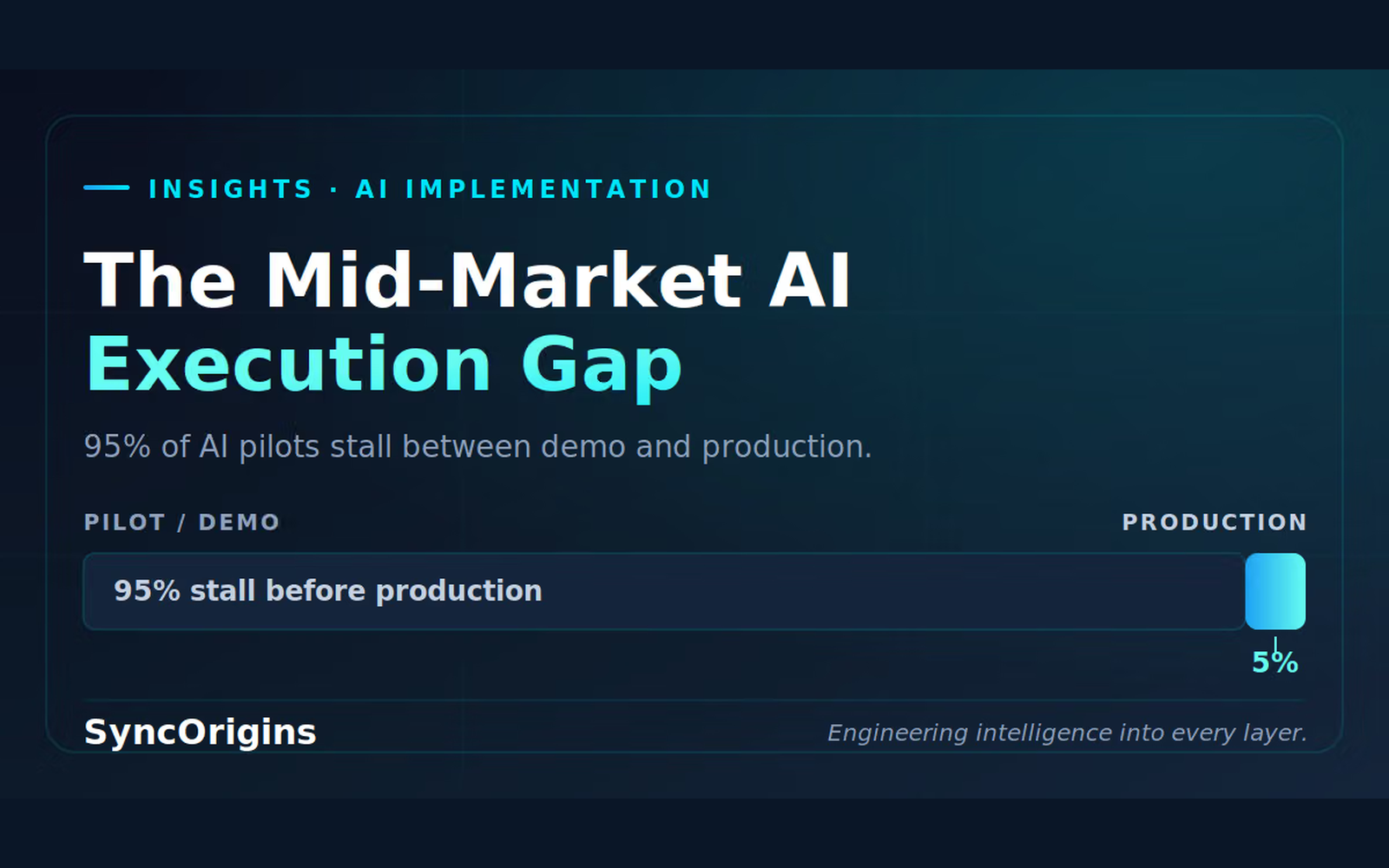
The number every leader should sit with: 95%
MIT's NANDA research found that 95% of enterprise generative AI pilots deliver no measurable impact on the P&L. Independent 2026 analyses land in the same place: roughly 88% of AI pilots never reach production, and 42% of AI projects show zero return — with a striking 61% approved on projected ROI that no one measured after launch.
Read those numbers carefully, because the obvious conclusion is the wrong one. The technology is rarely the problem. In almost every failed pilot, the model works. The demo impresses the steering committee. Then the project dies on contact with real workflows.
MIT's own framing is blunt: the failure is one of enterprise integration, not model quality. Generic tools stall because they don't learn from or adapt to how a specific business actually runs. Gartner adds the deeper root cause — it predicts 60% of AI projects lacking AI-ready data will be abandoned through 2026. The intelligence layer is only ever as good as the data and systems beneath it.
Why the mid-market is uniquely exposed ?
Here's the paradox buried in the 2026 adoption data. Mid-market companies are actually adopting agentic AI faster than large enterprises fewer approval layers, more appetite, and a wave of turnkey tools lowering the barrier to entry. Agentic AI in Manufacturing is emerging as a particularly strong opportunity, as manufacturers look to automate complex workflows, improve operational decision-making, and turn existing data into measurable business outcomes.
And yet mid-market companies also record some of the highest project abandonment rates. The reason is structural: they face the full range of enterprise-grade failure drivers messy data, legacy systems, integration complexity but without the deep internal AI teams that large enterprises can throw at the problem.
Fast to start. Fast to stall. A pre-built suite gets you to a working demo quickly, but the demo was never the hard part. Nearly 60% of AI leaders cite integration with legacy systems as a primary adoption challenge and no off-the-shelf agent solves that for you.
Buy, build, or something more deliberate
The instinct is to frame this as buy versus build. The data has a clear opinion: purchased and partner-led AI solutions succeed about 67% of the time, while internal builds succeed only one-third as often. Going it entirely alone is the riskiest path on the board.
But "buy a managed suite" and "build it all yourself" aren't the only two options — and treating them as such is how mid-market companies end up with a polished tool that never touches their core systems. The third path is the one the successful 5% actually take: engineer the specific integration between a proven AI capability and the workflow it is meant to transform.
That distinction is everything. The winners in MIT's data share a consistent pattern — they pick one high-value workflow, integrate deeply, and design for measurable outcomes from day one.
What the 5% do differently
Across the research, the survivors follow a recognisable playbook. It has almost nothing to do with which model they chose:
→ They start with one workflow, not a platform. One high-volume, high-friction process not a company-wide "AI transformation." Value is proven before scope expands.
→ They fix the data foundation first. AI-ready data governed, clean, available close to real time is treated as the prerequisite, not an afterthought discovered three months in.
→ They engineer into existing systems. The agent reads from and writes to the ERP, CRM, and databases the business already runs on. Integration is the product, not a footnote.
→ They define success before launch. A specific, measurable P&L or operational metric is agreed up front so the project can't quietly become one of the 61% no one ever measured.
→ They redesign the workflow, not just automate it. Deloitte found 48% of organizations introduced AI without redesigning the roles or workflows around it. The ones reporting an average 171% return did the opposite.
The execution gap is an engineering problem
The Accenture–Google announcement is good news: it confirms agentic AI is now genuinely within reach for mid-market companies, and it clears away a lot of the "which model, which platform" noise. But making AI easy to buy does not make it easy to land. The 95% failure rate lives entirely in the space between a capable model and a production system wired into how a business actually operates.
That space is engineering. Data pipelines that make information trustworthy in hours, not quarters. Integrations that connect an agent to the systems of record. Success metrics instrumented from the first sprint. Workflows redesigned so the AI has somewhere real to plug in.
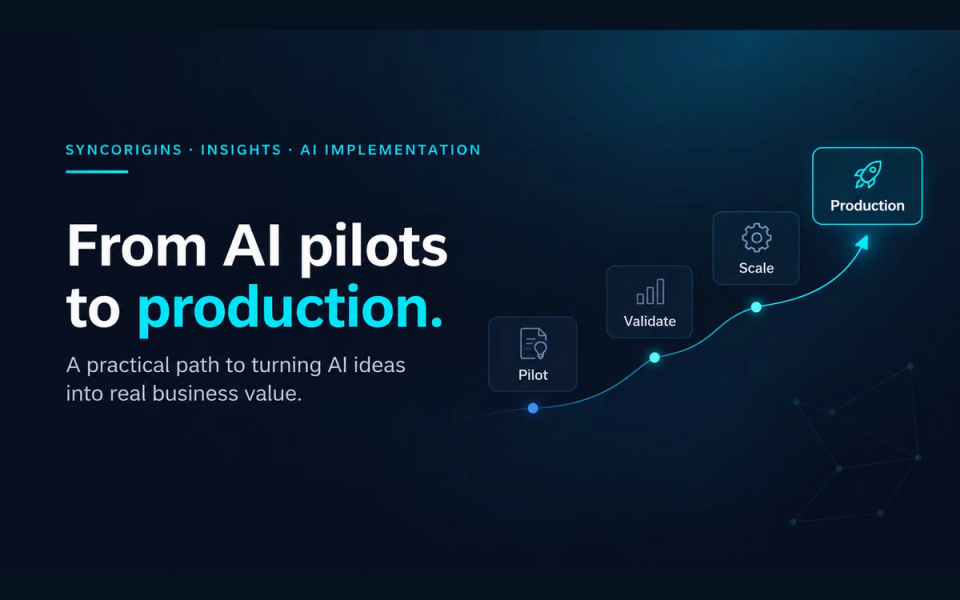
This is exactly the wedge SyncOrigins is built for. Not another platform to license, and not a deck about AI's potential but the engineering execution that turns a promising pilot into a system that moves a number your CFO can point to.
The most reliable way to find out whether AI will work in your business is not a twelve-month transformation programme. It's a fixed-scope proof of concept on one real workflow, engineered end to end, with a measurable outcome defined before a line of code is written. Prove the P&L impact once then scale from evidence, not optimism.
The question isn't whether to adopt agentic AI in 2026. It's whether your next pilot will be one of the 5% that ships, or one of the 95% that quietly gets reallocated. That difference is decided in execution.