
What Is ERP Staff Augmentation?
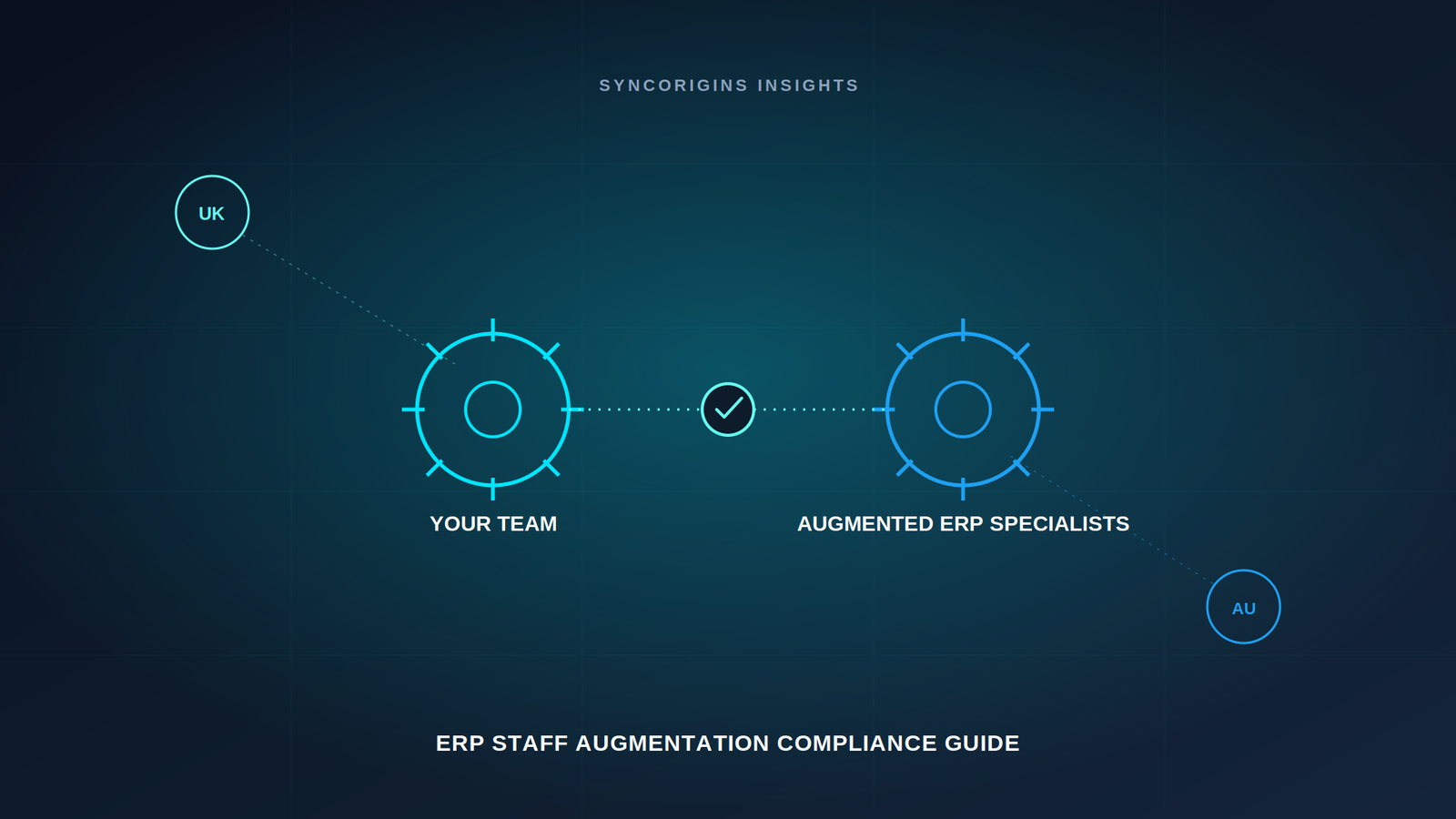
ERP staff augmentation means bringing external specialists, such as SAP consultants, Oracle developers, and integration engineers, into your existing team for a defined ERP project. Your internal team retains control over project direction, daily workflows, and delivery decisions.
Unlike outsourcing, where a vendor typically takes ownership of the project outcome, staff augmentation extends your existing team with specialized ERP expertise. The consultants become an extension of your team rather than a replacement for your management.
For mid-market companies in the UK and Australia, this distinction matters because the engagement model can affect compliance responsibilities, contractual structures, data handling, and operational accountability.
Why Are Mid-Market ERP Teams Using Staff Augmentation in 2026?
The demand for certified ERP consultants continues to put pressure on businesses, particularly those operating in complex or regulated industries. SAP skills, for example, remain difficult to source, which can increase consulting rates and extend implementation timelines.
At the same time, ERP modernization has become increasingly important for mid-sized businesses. AI-enabled ERP can help manufacturers and other organizations automate processes and improve decision-making, but these capabilities depend on an ERP environment that can support modern data and AI workloads.
This creates greater competition for specialized consultants.
ERP staff augmentation provides a practical way to address this talent shortage. Businesses can access specialized expertise within weeks instead of waiting months for permanent hiring, while avoiding a long-term employment commitment for projects with defined timelines.
UK ERP Staff Augmentation Checklist
For UK companies evaluating ERP staff augmentation, compliance should be addressed before the contract is signed. IR35 status determination is one of the first considerations.
Confirm IR35 Responsibility
Determine who is responsible for making the IR35 status determination. Under the UK's off-payroll working rules, responsibility can depend on the nature and size of the engaging organization and the contracting structure, so the arrangement should be assessed before work begins.
Evaluate the EOR Structure
Ask whether the engagement uses an offshore Employer of Record, or EOR, model. Under an EOR structure, the EOR acts as the legal employer of the consultant in the relevant jurisdiction. However, businesses should still obtain professional advice to confirm how the specific structure affects their tax and employment obligations.
Review GDPR and Data Protection Requirements
Make sure data protection responsibilities are clearly defined in the contract, particularly when consultants will access financial, HR, customer, or other sensitive ERP data.
Review areas such as:
- Data access and permissions
- Data processing responsibilities
- Cross-border data transfers
- Security requirements
- Data retention and deletion
- Incident reporting
Check the Partner's Compliance Experience
Do not rely solely on claims made during a sales process. Ask about the provider's experience with UK engagements, compliance processes, and relevant client references.
Australia ERP Staff Augmentation Checklist
Australia presents a different set of considerations. The country's growing demand for technology professionals makes access to specialized AI, cybersecurity, cloud, and ERP expertise increasingly important for modernization projects.
Verify Australian Market Presence
Confirm the provider's actual presence in Australia rather than relying solely on an Australian domain or local sales contact.
Understand whether the provider operates through:
- An onshore delivery model
- An offshore delivery model
- A hybrid delivery model
- A local entity with offshore delivery resources
This distinction can affect communication, delivery, compliance, and escalation processes.
Assess Australian Regulatory Knowledge
Ask whether consultants and delivery teams understand the regulatory requirements relevant to your industry and project.
This becomes particularly important when ERP Transformation systems handle financial, employee, customer, or other regulated information.
Review Independent Provider Evidence
Cross-check the provider through independent sources such as Clutch, GoodFirms, or The Manifest, along with direct referrals where available.
Look beyond testimonials and examine evidence of relevant ERP experience, delivery capability, and client outcomes.
Ask About Consultant Continuity
Clarify what happens if a consultant leaves during the project.
Before signing, ask about:
- Replacement timelines
- Knowledge transfer
- Documentation requirements
- Handover processes
- Backup resources
- Continuity commitments
These expectations should be documented contractually rather than relying on verbal assurances.
What Do UK and Australia Have in Common?
Although the compliance considerations differ between the UK and Australia, both markets share an important ERP staff augmentation risk: continuity and accountability.
The key difference between staff augmentation and managed services is ownership.
With staff augmentation, your organization generally retains project ownership and management responsibility. The external consultants provide additional skills and capacity, but your internal team remains responsible for governance, priorities, and delivery oversight.
That model works well when your organization has a clear internal owner for the ERP project.
For an ongoing, business-critical ERP environment without strong internal ownership, staff augmentation alone may create accountability gaps. These gaps can remain hidden until a consultant leaves, a project encounters delays, or a critical issue requires escalation.
Before signing an ERP staff augmentation agreement, ask one important question:
Who owns the outcome if an augmented consultant leaves mid-project?
The answer should be clearly defined in the contract.
UK vs Australia ERP Staff Augmentation Priorities
| Priority | UK | Australia |
|---|---|---|
| Primary consideration | IR35 status and contracting structure | Regulatory and data sovereignty requirements |
| Key structural consideration | EOR or appropriate contracting model | Verified local presence and regulatory knowledge |
| Talent challenge | Limited availability of specialized digital skills | Growing demand for technology and cloud skills |
| Due diligence | Compliance experience and client references | Independent reviews, references, and delivery evidence |
| Continuity focus | Replacement and contractual responsibilities | Handover, local support, and replacement processes |
How SyncOrigins Approaches ERP Staff Augmentation
SyncOrigins approaches Managed Delivery & Staff Augmentation through outcome-based engagement rather than simply filling headcount gaps.
Before consultants begin work, the engagement structure, contractual responsibilities, compliance requirements, and continuity expectations are established. This creates a clear delivery foundation before specialized resources join the project.
For businesses planning ERP projects in the UK or Australia, SyncOrigins combines ERP expertise with structured delivery support to help organizations access specialized capabilities while maintaining clear ownership and accountability.