
What's the Difference Between AI Implementation and ERP Transformation?
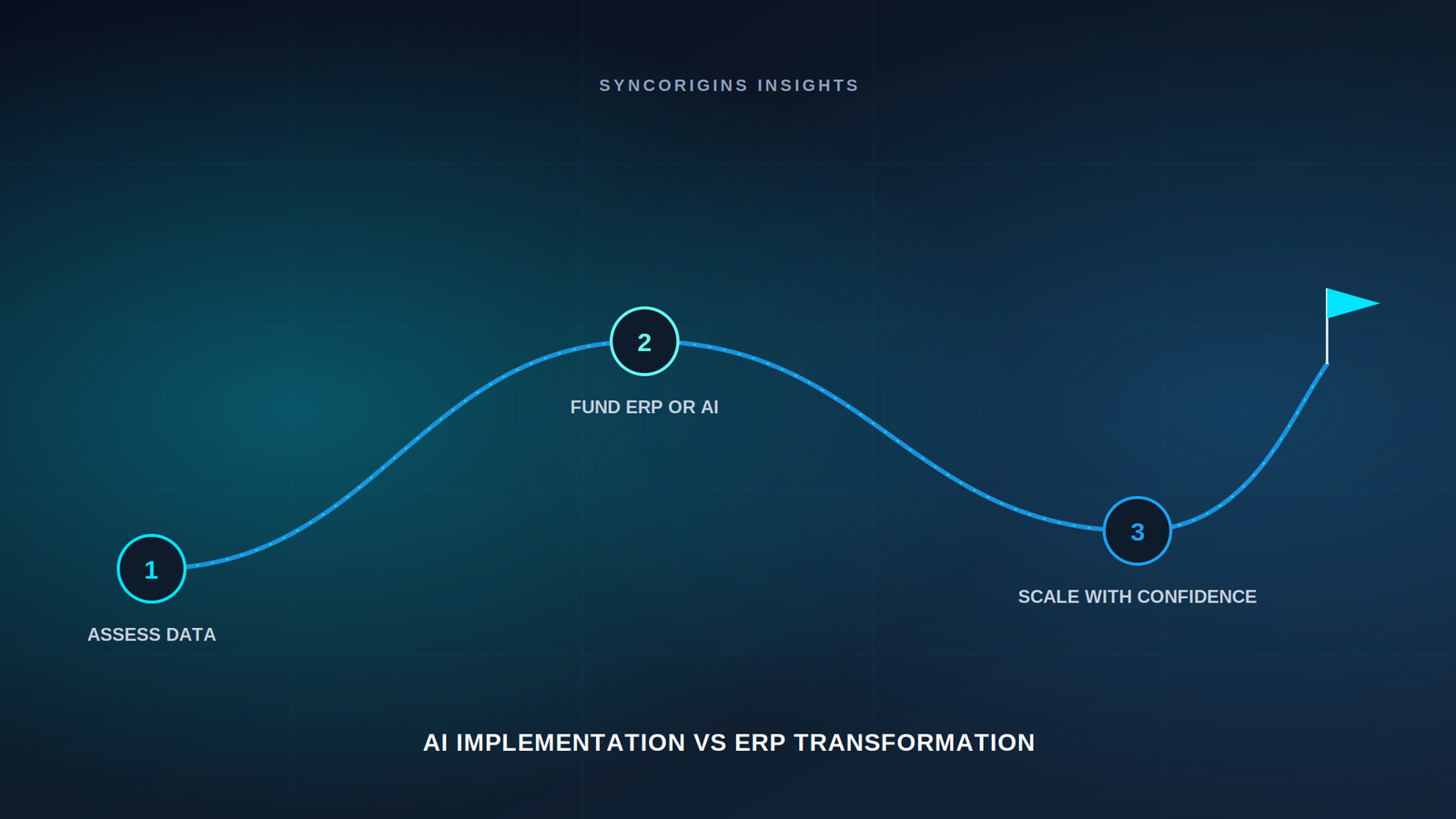
AI implementation means deploying machine learning models or AI agents to automate a specific decision or task, demand forecasting, quality inspection, customer support. ERP transformation means modernizing or replacing the core system of record that runs planning, inventory, finance, and operations across the business. They are not competing investments. They are sequential ones, and funding them in the wrong order is the most common reason mid-market manufacturers see AI initiatives stall.
This is the question we hear most often from operations leaders this year, and it usually arrives the same way: a board has approved budget for "AI," a vendor has shown an impressive demo, and someone has to decide whether that budget goes toward an AI pilot or toward fixing the ERP system everyone already complains about. Below is how to think about that decision with actual numbers behind it, not vendor slides.
Why This Question Is More Urgent in 2026 Than It Was a Year Ago
The honest answer is that AI capability has outpaced the data foundations most mid-market manufacturers have to support it. Mid-market manufacturers are increasingly told to treat shop-floor automation and ERP modernization as a single initiative rather than two separate budget lines, because automation only creates value once that data flows into planning, inventory, labor, and logistics workflows.
That's not a minor caveat. It's the entire reason so many AI pilots impress in a demo and then quietly disappear six months later.
The Data-Readiness Gap Nobody Puts in the Pitch Deck
Here's the uncomfortable number: research from Boston Consulting Group found that roughly 74% of companies struggle to scale value from AI, and only about 26% have built the capabilities needed to move beyond proof-of-concept into tangible value. The same research breaks down why AI initiatives stall, and the breakdown is the part most pitch decks leave out: around 70% of AI implementation challenges come from people- and process-related issues, 20% from technology problems, and only 10% from the AI algorithms themselves — even though the algorithms are what consume most of the budget conversation.
Put plainly: the model is rarely the bottleneck. The data feeding it is.
This is why McKinsey now frames AI and ERP as two halves of the same problem rather than two separate budget lines. Their research describes companies creating a "great divide" — pouring investment into AI use cases while treating the ERP Transformation system that holds the underlying data as legacy overhead to be tolerated rather than upgraded. Only about 40% of companies report any enterprise-level EBIT impact from their AI initiatives so far, and the firm explicitly calls out "pilot purgatory" — a proliferation of AI experiments that aren't supported by the end-to-end processes, data, and systems needed to scale them.
When ERP Transformation Has to Come First
If any of the following is true in your operation, ERP work needs to be funded before the AI pilot, not after it:
- Your item, supplier, inventory, or location data lives in more than one system of record, and nobody can tell you with confidence which version is "correct" right now.
- Your planning team still reconciles data in spreadsheets between what the ERP shows and what actually happened on the floor.
- You don't have consistent, timestamped event capture meaning you can't reliably answer "what happened, when, and in what sequence" without manual digging.
Manufacturers need clean, structured, trusted data accurate item, order, inventory, location, supplier, carrier, and timestamp data, plus consistent event capture across workflows — because AI only delivers value when operational signals are complete, timely, and tied to real business context. An AI agent layered on top of fragmented, untrusted data doesn't fix the fragmentation. It just makes bad decisions faster and with more apparent confidence.
When an AI Pilot Can Safely Come First
The calculus flips when the use case is narrow, the data it needs already lives in one clean source, and the pilot is genuinely scoped to prove value rather than reshape an entire workflow. This is also where most pilots that do succeed share a common pattern: organizations don't start by asking "how do we use AI?" They start by auditing one high-volume, error-prone process, defining success metrics upfront, and building one agent for one workflow with one integration then measuring against a baseline before expanding.
If your highest-friction process already sits inside a single, reasonably clean data source a quality-inspection log, a single warehouse management system, a defined customer-service queue a tightly scoped AI pilot can run in parallel with ERP work rather than waiting for it.
A Practical Sequencing Framework
| Situation | Fund first |
|---|---|
| Data lives in 3+ disconnected systems, manual reconciliation is routine | ERP transformation |
| Core ERP is reasonably current, but one specific workflow is data-isolated and high-friction | AI pilot (narrow scope) |
| ERP migration is already underway or recently completed | AI implementation, sequenced to the new data model |
| Neither system nor process ownership is clearly assigned for the target workflow | Neither — assign ownership first |
This last row matters more than it looks. Manufacturers that pursue "big bang" ERP go-lives chasing speed often concentrate risk at the point of transition, and the more durable approach prioritizes phased sequencing readiness over headline go-live dates aligning the rollout with what the organization can actually absorb. The same discipline applies to AI: a narrow, well-sequenced pilot beats an ambitious one that outruns the data behind it.
What This Means for Your 2026 Budget Conversation?
If you're choosing between funding an AI pilot or an ERP fix this year, the question to ask isn't "which is more exciting to the board." It's: can the AI pilot's data need be satisfied by what already exists cleanly today? If yes, pilot now. If the honest answer is "we'd need to clean up three systems first," that cleanup is the actual AI investment it just doesn't get called that in the budget line.
How SyncOrigins Approaches This?
We run a fixed-scope AI proof-of-concept specifically designed to surface this answer before you commit to a larger program a short, bounded engagement that tells you whether your current data foundation can support the AI use case you have in mind. SyncOrigins helps businesses use this engagement to identify whether their data is AI-ready or whether ERP work needs to come first. If you're weighing this decision for your own operation, get in touch at (hello@syncorigins.com) to talk through where you actually stand.