
A mid-market retailer switches on its new AI shopping agent across the entire site. It greets visitors, recommends products, upsells at the basket, answers stock questions, and handles returns. Six weeks later the dashboard shows healthy “deflection,” yet conversion has not moved. The agent has twice quoted a delivery date the warehouse could not honour. The merchandising team has quietly disabled it on the three category pages that actually drive revenue. Nobody in the room can answer the only question that matters: what was it supposed to improve?
This is the most common retail-agent outcome of 2026 — and it is almost never a model problem.
The market is real. The failure rate is too.
The demand is not hype. Agentic AI in retail and e-commerce is estimated at around $60 billion in 2026 and growing near 29% a year (Mordor Intelligence). Shoppers who engage an e-commerce agent convert at 12.3% versus 3.1% for unassisted browsers — roughly a fourfold gap across 329 brands (Alhena AI). McKinsey puts AI-generated recommendations at 4.4x the conversion of traditional search, and sizes agentic commerce at $3–5 trillion globally by 2030.
And yet MIT’s Project NANDA found that only about 5% of enterprise GenAI pilots reached measurable P&L impact. The same study reported that tools deployed with a specialist vendor partner reached production around 67% of the time, against roughly 33% for internal builds — figures drawn from a small, self-reported sample, so treat them as indicative of direction rather than precise. The direction, though, is corroborated on the shop floor: ChannelEngine data shows 58% of shoppers research with AI but only 17% complete a purchase through it, and Adobe scored the average product page just 66% machine-readable — meaning a third of the page an agent needs to read simply is not there.
The retail agent that wins is not the one that can do everything. It is the one scoped to do a single job so reliably that a merchandiser stops checking its work.
| • | A retail AI agent is a system that pursues a bounded commercial goal on a shopper’s or operator’s behalf — it takes actions (books, reserves, reprices, resolves) rather than only answering questions. |
|---|---|
| • | Customer-facing agents handle discovery, size-and-fit guidance, replenishment, order status, and returns triage — the moments where a confident, correct answer converts. |
| • | Operations-facing agents handle dynamic pricing, stock allocation, supplier follow-ups, and catalogue enrichment — the unglamorous work that compounds on margin. |
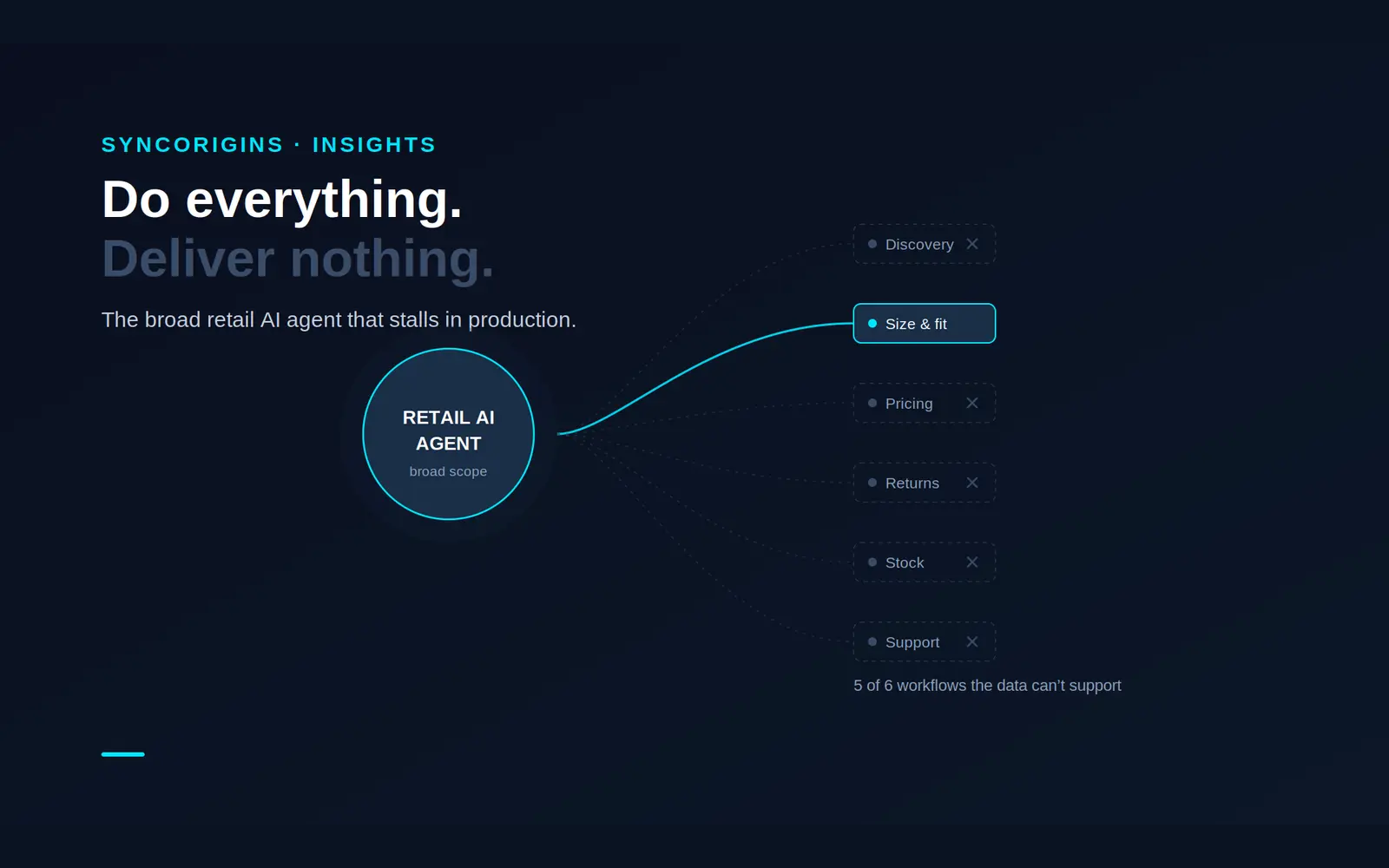
| • | The distinction that matters is scope, not surface. A narrow agent wired into one workflow behaves predictably; a broad “concierge” bolted across the whole journey inherits every gap in the data beneath it. |
The uncomfortable thesis: scope beats capability
The prevailing narrative treats the retail-agent race as a contest of capability — whoever ships the most capable general assistant wins. The evidence says the opposite. Value is captured by agents scoped so tightly that their success is measurable in a single number, and the binding constraint is almost never the model.
The constraint is the data the agent can read and the actions it is permitted to take safely. An agent asked to advise on fit cannot do so if 34% of the product page is invisible to it. An agent that can quote a delivery date but cannot see the order-management system will invent one. This is why broad deployments stall: they expose the agent to workflows the underlying systems were never structured to support. The fix is not a smarter agent — it is a narrower one, sitting on a data-and-permission layer that has been engineered, not assumed.
That is the defensible position for a services firm, and it is the opposite of the platform pitch. The winners are not buying the biggest model; they are engineering one reliable job end to end, then earning the right to the next one.
| 1. | Pick one job with a number attached to it. Not “improve CX” — “cut returns-related contacts by 20%” or “lift size-confidence conversion on footwear.” If you cannot name the metric it moves, you cannot tell whether it worked. |
|---|---|
| 2. | Audit what the agent can actually read. Score product-page machine-readability, feed completeness, and structured data before writing a line of prompt. The agent inherits the quality of the catalogue beneath it. |
| 3. | Define the action boundary and the recovery path. Decide exactly what the agent may do autonomously, where it must hand off to a human, and how a wrong action is caught and reversed. Verifiability first; autonomy second. |
| 4. | Wire it to systems of record, not screenshots. Connect the OMS, inventory, and pricing APIs directly so answers reflect live truth. An agent reasoning over stale or scraped data will fail confidently. |
| 5. | Instrument against the baseline, not deflection. Deflection rate flatters; it does not prove value. Measure the business number you named in step one, against a pre-agent baseline, with a hold-out where possible. |
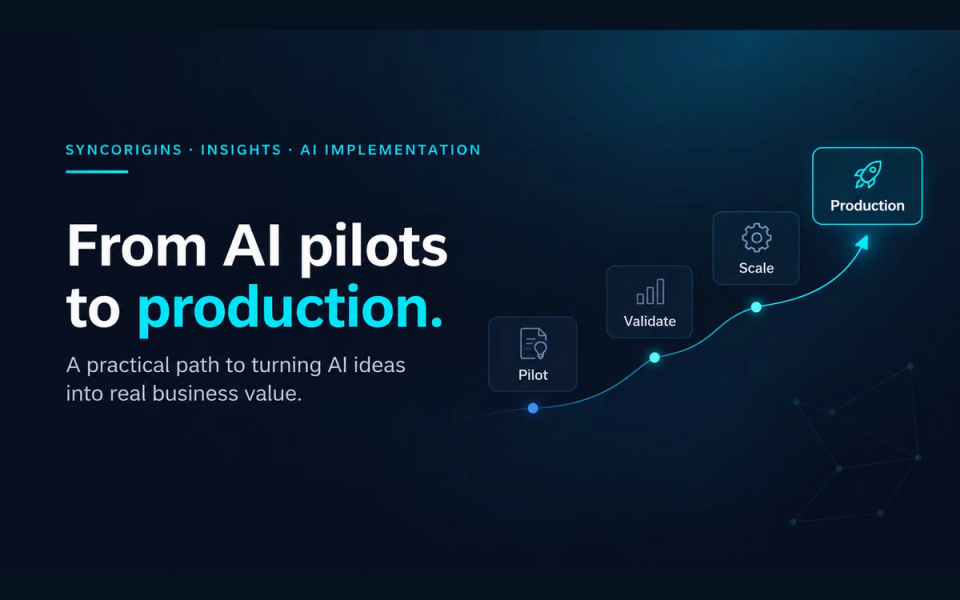
| 6. | Expand only after the first job is boring. When the merchandising team stops checking its work, add the adjacent workflow. Land narrow, earn trust, then widen — the pattern that reaches production twice as often as a big-bang build. |
The honest close
The retail-agent market is large, real, and moving quickly — and it is not a blue ocean. Most of the visible failures are not failures of artificial intelligence; they are failures of scope and plumbing wearing an AI costume. A retailer that ships one narrow, verifiable, well-instrumented agent this quarter will learn more — and earn more — than one that spends the year evaluating platforms.
The capability is already sufficient. The engineering is the differentiator. That is the layer worth investing in.