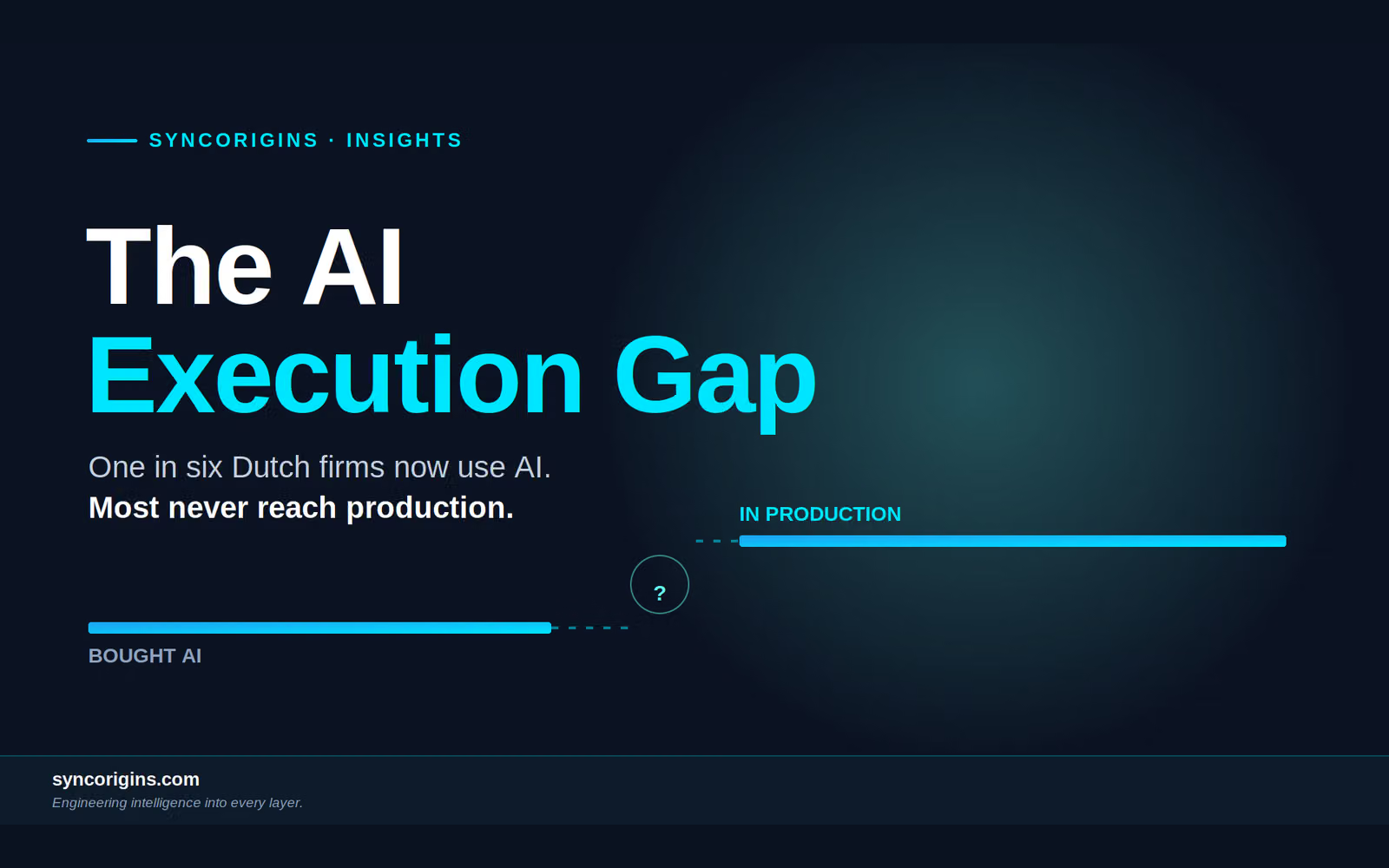

A €600M Dutch manufacturer signs off on an AI budget in January. By summer it has a copilot licence for every knowledge worker, two vendor pilots running, and a marketing team generating campaign copy that's measurably faster to produce. On paper, the company “uses AI.” In the numbers that matter — margin, cycle time, decisions made without a human in the loop — nothing has moved. The pilots never reached production. The data underneath them was never ready. And the one workflow that would have paid for the whole programme is still stuck in a proof of concept nobody will sign off on.
This is not a failure of ambition. It's the shape of the gap that sits underneath the Netherlands' AI adoption story — and it's most acute exactly where mid-market firms live.
The headline hides a market splitting in two
The headline is real. Statistics Netherlands (CBS) reports that one in six Dutch companies used AI in 2025, double the share from two years earlier, with the sharpest rise among mid-sized firms of 50 to 250 employees — from 20 percent in 2023 to 45 percent in 2025. Read quickly, that looks like a market catching up.
Read closely, it's a market splitting in two. AI use still climbs steeply with company size: CBS puts adoption at 59 percent among firms with 500 or more workers and under 18 percent among the smallest. The gap between the enterprise and the mid-market isn't closing — it's where the competitive pressure now concentrates. The most telling figure in the CBS data makes that concrete: firms using AI generated 51 percent of total Dutch business turnover in 2024, while making up under 23 percent of all companies. Adoption is no longer an efficiency story. It's a revenue-share story, and the mid-market is on the wrong side of it.
So why do capable firms stall? CBS asked the ones that considered AI and didn't proceed. The top reason, by a wide margin, was lack of experience — cited by three in four. Privacy was next, named by more than half of firms with 100 or more workers, followed by legal uncertainty. Notice what isn't on that list: the tools. Nobody stalled because the models weren't good enough.
The barriers that stall mid-market AI aren't strategy problems or tooling problems. They're delivery problems — and you can't buy your way out of a delivery problem with more tools.
What the execution gap actually is
| • | Lack of experience is not a training problem you solve with a course. It's the absence of people who have taken an AI workload from pilot to production before and know where it breaks — the integration, the edge cases, the monitoring nobody scoped. |
|---|---|
| • | Privacy is not a reason to wait. It's a design requirement. Firms stall here because governance was treated as a compliance step at the end rather than an architecture decision at the start. |
| • | Legal uncertainty — sharpened across Europe by the EU AI Act — is real, but it paralyses only the teams without a defensible audit trail. A system you can explain and evidence is a system you can defend. |
Why “more” is the wrong answer
Here's the uncomfortable part, and it runs against most of what the market is selling. The standard prescription for a stalled AI programme is more — more tools, more pilots, more platform. It's the wrong instinct. Every one of the barriers above gets worse, not better, when you add surface area. A second copilot doesn't fix a missing data foundation. A third pilot doesn't create the production experience the first two lacked. More sprawl is more places to stall.
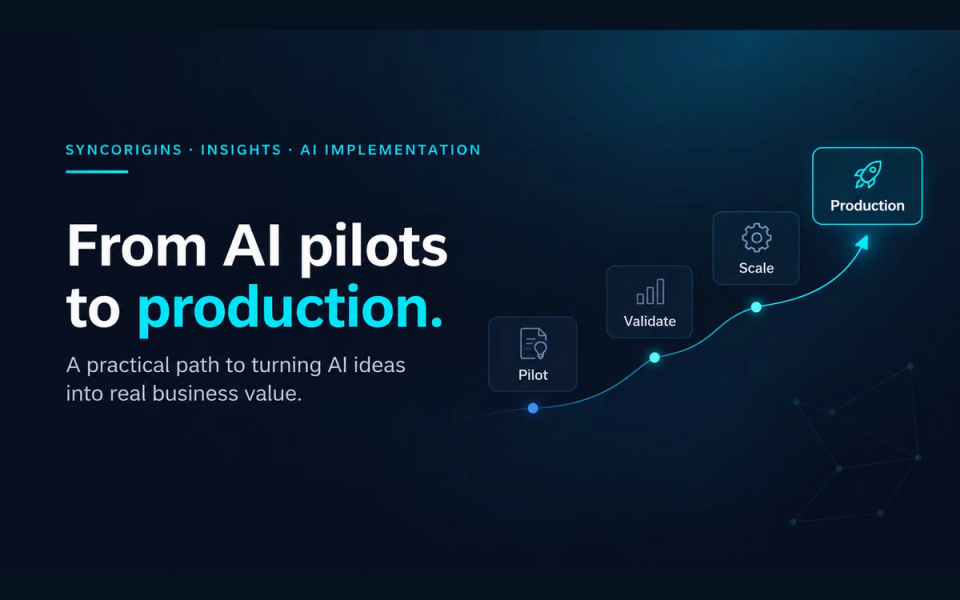
The firms that cross the gap do the opposite. They narrow. They pick one workflow where success is measurable, build the data and governance underneath it properly, and ship that one thing to production before starting the next. This isn't a hunch — it's the pattern in the evidence. MIT's Project NANDA found that narrowly scoped AI deployments succeed at roughly 67 percent, against about 22 percent for general-purpose ones. The widely quoted “95 percent of AI projects fail” figure isn't a verdict on the technology. It's a verdict on scope. Failure here is a procurement-design problem, and it's solvable.
That's the wedge, and it's the opposite of what a tool vendor or a staffing marketplace can offer. Access to a platform, or access to people, still leaves you owning the integration, the governance, and whether the thing ships. What closes the gap is delivered outcomes with a name against them.
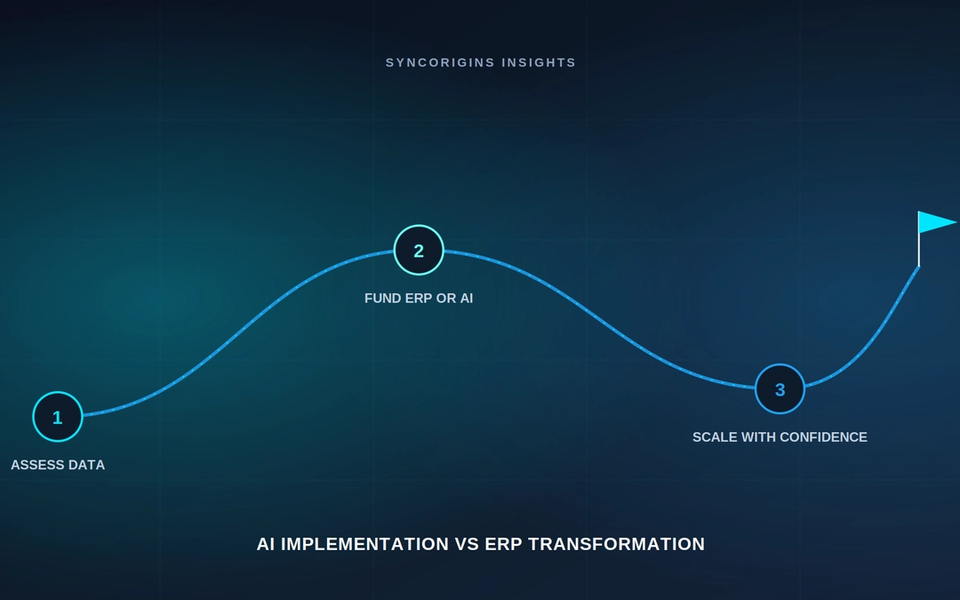
| 1. | Scope to one measurable workflow. Not a strategy, not a platform — a single process where you can state what success is in a number before you start. |
|---|---|
| 2. | Fix the data foundation first. Most pilots fail below the model, in ungoverned, unqueryable data. This is the unglamorous work that decides everything downstream. |
| 3. | Build governance in from the first commit. Privacy and auditability are architecture, not paperwork. Design them in and the legal-uncertainty barrier stops being a blocker. |
| 4. | Ship to production, then measure. A pilot that never leaves the sandbox has produced no evidence. Get one workflow running against real operations and hold it to the number you set. |
| 5. | Only then, scale the pattern. With one accountable win in production, the second workflow is a repeat of a known sequence — not another leap into a pilot. |