
A mid-market manufacturer sets a public target: cut energy intensity 20% by 2028. The board signs off, the press release goes out, and the sustainability page on the website gets a new banner. Eighteen months later, someone asks a fairly obvious question in a board meeting — which of our 40 machines are actually responsible for the waste, and how much have we cut so far? Nobody has a real answer. The utility bill dropped a little, but so did output that quarter, so the number doesn't actually tell you anything. There's no machine-level baseline, no idle-time data, nothing that ties a saving to a specific line or shift. The target was real. The measurement to prove it was never built.
This is the gap a lot of sustainability programmes fall into right now. Setting the commitment is the easy part. Building the data to run it — and later defend it — usually isn't.
The pressure to close that gap is coming from three directions at once, and it's building faster than most sustainability roadmaps account for. Energy costs keep climbing, so waste has become a line item rather than a talking point. Tier-1 buyers in automotive, aerospace and electronics are starting to write real-time traceability and production-level emissions data into supplier qualification, not just a vendor questionnaire once a year. And what used to be a pilot project — AI energy management on the plant floor — is fast becoming table stakes rather than a differentiator. Industry surveys of manufacturers now report machine-level power monitoring routinely uncovering somewhere around 8 to 15 percent of energy waste sitting in idle-running equipment alone, with annual savings in the tens of thousands of dollars per facility once someone actually fixes it. That number isn't sitting in the utility bill. It's sitting on the plant floor, unmeasured, usually because nobody's looking.
A sustainability target and a machine on the plant floor are the same problem, really: neither means much until someone can point to the sensor, the meter or the log that proves it.
What we're actually talking about
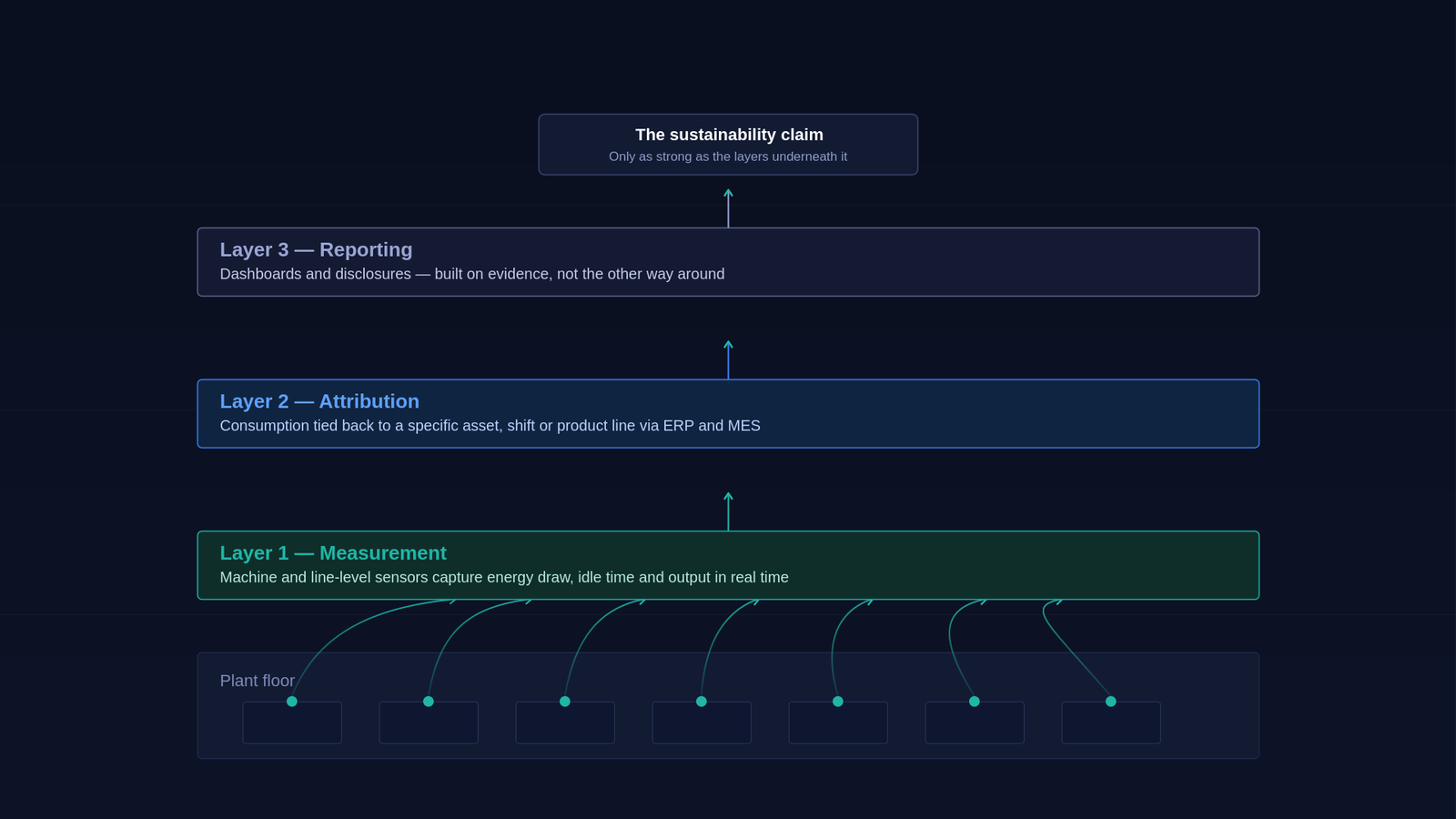
Strip away the sustainability language and this is an operational data problem with three layers. The first is measurement — sensors and meters at the machine, line or facility level capturing energy draw, idle time and output in real time, instead of a monthly number pulled off the utility bill. The second is attribution: tying that consumption back to a specific asset, shift or product line, so a saving can be traced to a cause rather than guessed at. The third is reporting — turning that operational data into the emissions and energy figures a customer, auditor or regulator will actually accept.
Most manufacturers have built the third layer and skipped the first two. They've got an AI sustainability solutions dashboard with no real sensor data underneath it, which means most of the numbers on that dashboard are estimates dressed up as facts. That's exactly where audits fail and tenders get lost — a plant can hand over a compliant-looking report and still have nothing to say when a customer's procurement team asks how the number was actually derived.
How we sequence it
In our delivery work, a sustainability data foundation for a manufacturing or industrial client gets built in a fairly deliberate order — bottom-up from the sensor, not top-down from the report.
1. Instrument before you commit to a number. Install or activate machine-level and line-level metering before setting a target you'll be measured against later. A target set on a utility-bill baseline rarely survives scrutiny once someone actually checks it.
2. Separate idle waste from process waste. Machine-level monitoring is usually the fastest way to find real savings, because idle-running equipment is consistently one of the largest and easiest-to-fix sources of energy loss on a plant floor. Fix this layer first, before anything more complicated.
3. Build the attribution layer. Connect consumption data to specific assets, shifts and product lines through the ERP and MES, so every saving — and every regression — has a traceable cause instead of an assumption behind it.
4. Feed predictive maintenance from the same data. The sensors that catch energy waste are largely the same ones that catch early-stage equipment failure. This is also where smart manufacturing investment actually pays for itself twice — build both on one data layer instead of instrumenting the plant twice.
5. Map to whatever framework your customers actually require. Scope 1 and 2 operational data, a customer's supplier scorecard, a carbon declaration — the underlying machine data is largely the same across all of them. Model it once at the source and map outward as requirements shift, rather than rebuilding each time a rule changes.
6. Only then, automate the reporting. Dashboards and disclosures sit on top of instrumented, attributable data. Automating a report before the underlying measurement exists just automates the guesswork faster.
The honest version
None of this means every mid-market manufacturer needs a full digital-twin rollout this year, and the ROI case has to be made line by line rather than assumed. Instrumentation costs money, integration takes time, and not every facility sees the same payback — some pay for themselves in a year, some take three. What's changing is the cost of not doing it. The buyers who used to accept a spreadsheet are starting to ask for the sensor data behind it, and the plants that already have supply chain data transparency built in will win that conversation before the ones still writing the report ever finish it.
The target is the easy part. The machine data is where sustainability programmes are actually won. SyncOrigins helps manufacturers connect machine data, supply chain information, and enterprise systems to build measurable sustainability programmes backed by operational evidence.