A team connects a capable AI model to their data warehouse. They ask it a business question. It returns a fluent, confident, well-formatted answer.
The answer is wrong.
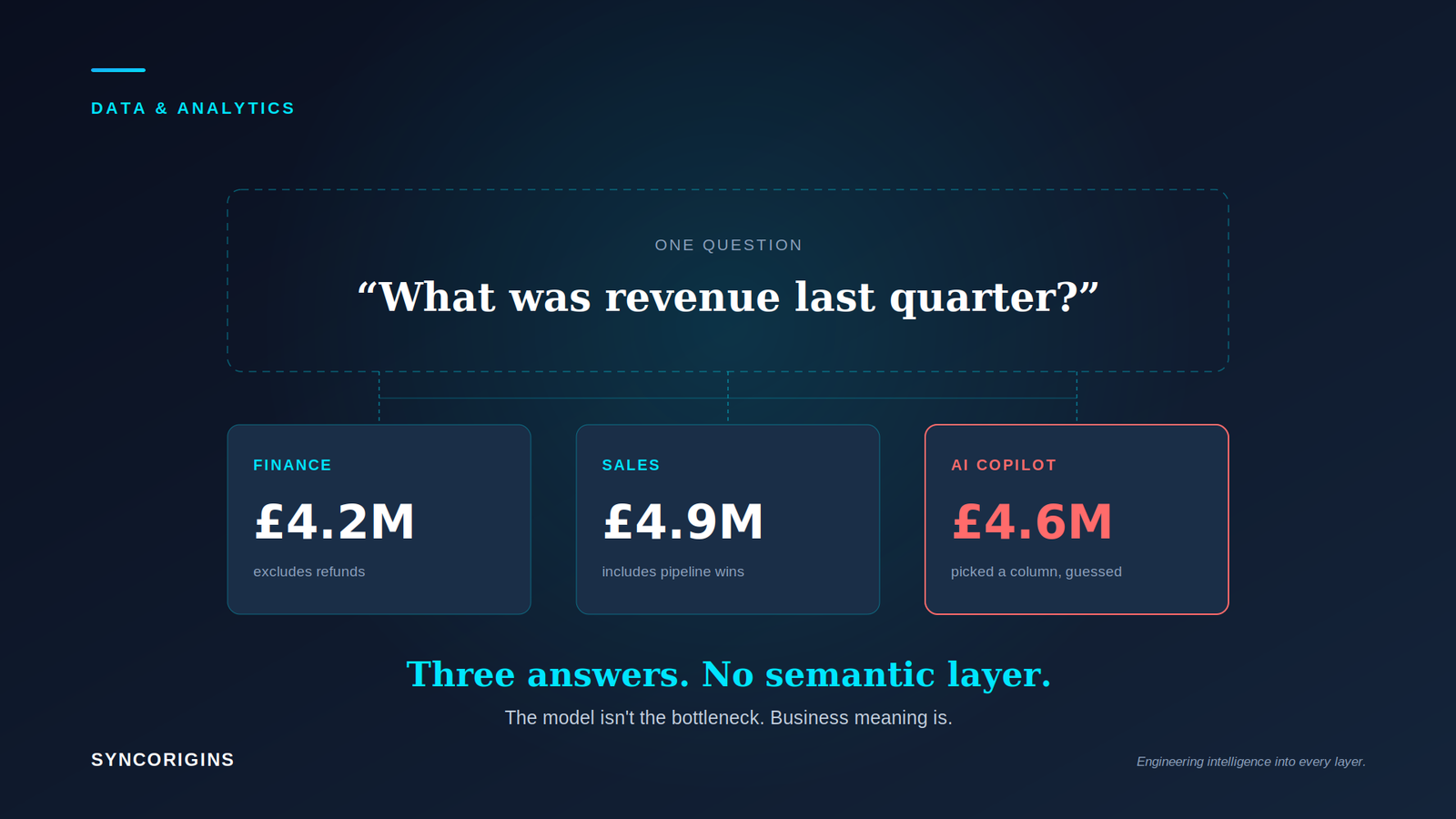
Not dramatically wrong — subtly wrong. It picked the revenue column that includes refunds. It joined at the wrong grain. It found three tables that could plausibly hold “lead time” and chose one. Nothing in the output signals any of this. The number looks like every other number the business has ever trusted.
The instinct at this point is to reach for a better model, a bigger context window, another round of prompt tuning. That instinct misdiagnoses the failure. The agent is not failing at reasoning. It is failing at business comprehension — and no model upgrade fixes that, because the missing information was never in the data in the first place.
The gap has a name, and analysts are now putting numbers on it
At the Gartner Data & Analytics Summit in 2026, analyst Andres Garcia-Rodeja predicted that 60% of agentic analytics projects relying solely on the Model Context Protocol will fail — specifically because they lack a consistent semantic layer. Gartner has also projected that by 2030, universal semantic layers will be treated as critical infrastructure alongside data platforms and security.
The readiness picture underneath is worse than most boards assume. A March 2026 report from Cloudera and Harvard Business Review Analytic Services found that only 7% of enterprises say their data is completely ready for AI. Not 70%. Seven.
And the upside is measurable. OpenAI’s January 2026 paper on its in-house data agent documented a complex query that took 22 minutes at baseline running in 1 minute 22 seconds once the full context stack was in place — on the same underlying model. Nothing about the intelligence changed. Everything about what it could see changed.
The model stopped being the hard part. What a metric means, who owns it, and whether a human would defend the number in a board meeting — that is the hard part.
| ● | The semantic model — what the data means. Entities, how they relate, measures, dimensions, synonyms. This is what tells an agent that “lead time” maps to days_to_delivery and not to one of the four other columns that look like candidates. |
|---|---|
| ● | Metric definitions — how a number is calculated. What counts as revenue. Whether cancelled orders are excluded. Whether it is a sum, a count, or the latest snapshot. |
| ● | Governance — ownership, lineage, certification, access. Without it, an agent can pull a perfectly real definition of revenue and still pick the wrong one, because nothing told it which definition the business stands behind. |
Why this is different from the data quality work you already did
This is the part that catches out organisations with genuinely mature BI. They have a warehouse. They have dbt. They have dashboards people use. And their first agentic pilot still produces answers nobody will sign off on.
The reason is cadence. Traditional data management runs on reporting rhythms — quarterly audits, monthly pipeline checks, annual governance reviews. That works when the consumer is a human reading a dashboard once a week, because a person notices when a number looks wrong. An agent gets no such sanity check. It consumes data continuously and acts on it across thousands of decisions nobody is individually reviewing. Quarterly governance feeding a system that operates in seconds is where most agentic analytics failures are actually born.
Clean data is not the same as legible data. You can have both a spotless warehouse and an agent that cannot tell which of your three revenue figures the CFO means.
| ● | Pick one question the business already argues about. Not a use case — a question. “What was net revenue by region last quarter?” If three teams currently produce three answers, that is your first target. |
|---|---|
| ● | Trace it backwards. Identify the exact tables, joins and business rules that question depends on. This is usually a much smaller surface than anyone expects, and it exposes the disagreements immediately. |
| ● | Define the metric once, in code, in a place that is not a BI tool. dbt Semantic Layer, Cube, AtScale, Snowflake Semantic Views, Databricks Metric Views — the right choice depends on the stack you already own. What matters is that the definition lives outside any single consuming tool, so dashboards, analysts and agents all read the same one. |
| ● | Attach governance to it. An owner, a certification status, lineage, access rules. This is what turns a definition into something an agent can cite and a human can defend. |
| ● | Point the agent at that, not at the warehouse. Then measure whether the answers hold up against a human analyst’s. |
| ● | Repeat for the next question. Context compounds. The second metric takes a fraction of the time the first did. |
Portability is the part to get right early
The one architectural decision worth being stubborn about: do not lock business meaning inside a single BI tool or a single cloud. The Open Semantic Interchange initiative — with dbt Labs, Snowflake and Salesforce collaborating on vendor-neutral metric definitions — exists precisely because the industry recognised how expensive that lock-in becomes.
Agent stacks will change. Your definition of an active customer should not have to change with them.
The honest version
You do not need a flawless data estate before you touch agentic AI. That standard does not exist, and waiting for it is its own failure mode.
What you need is meaning — governed, owned, and readable by whatever is asking the question. Define the minimum threshold for the one initiative in front of you, meet it, ship it, and improve from real usage.
The organizations pulling ahead are not the ones with perfect data. They are the ones who stopped pointing capable models at incomprehensible warehouses and expecting comprehension to emerge.