The real question is: who will own the delivery?
A product release is slipping. Your engineering team is already stretched, and the next project needs skills you do not have in-house. Do you bring in a couple of developers, or hand a defined piece of work to an external team?
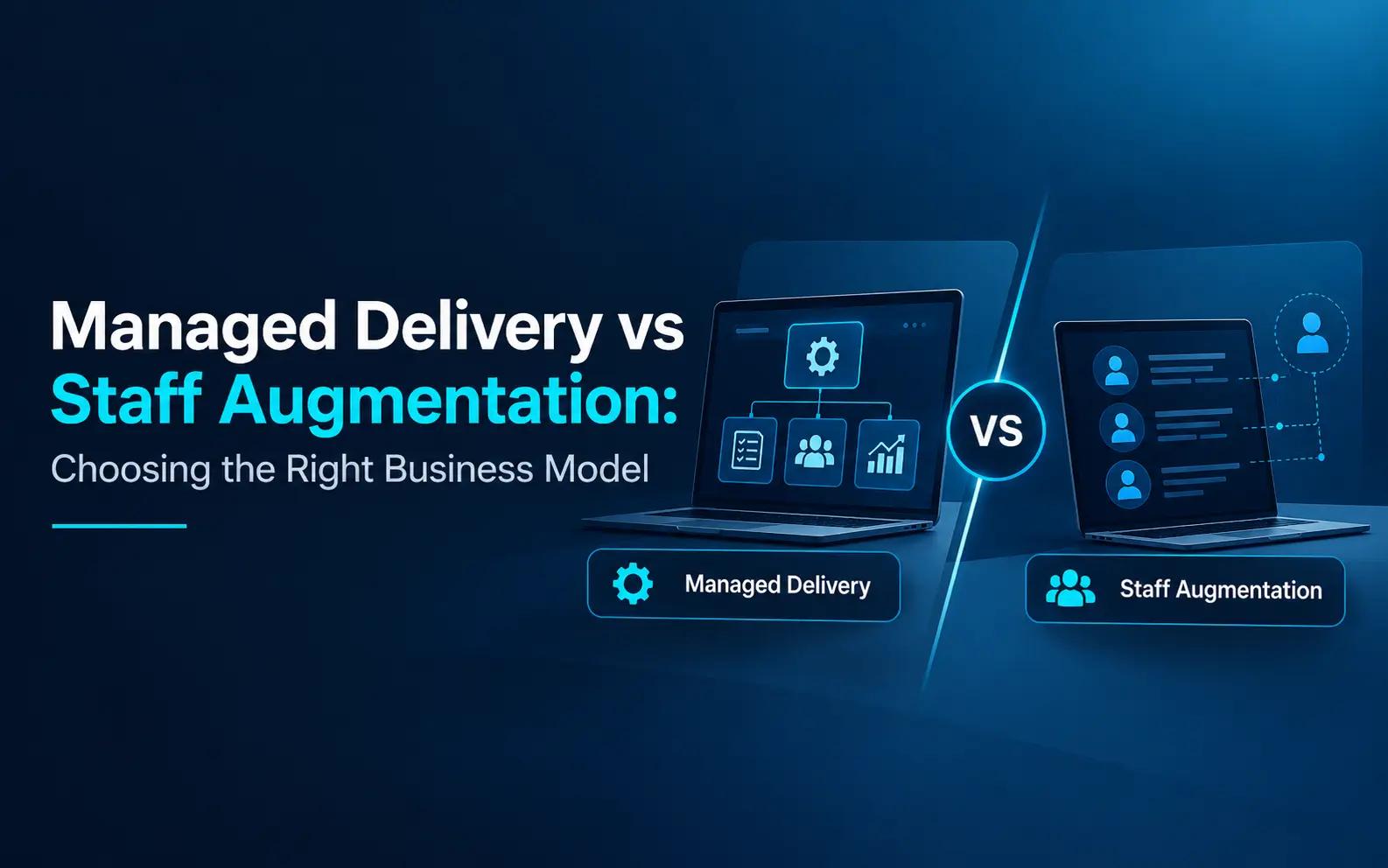
That decision is often described as staff augmentation versus managed delivery. Both can work well. The difference is not simply how many people you hire or where they sit. It is who sets priorities, manages the work, and is accountable for what gets delivered.
A company with strong technical leadership may only need extra hands. Another may have funding and a clear business goal, but not the capacity to coordinate engineers, testing and releases. Those businesses should not buy the same service.
What is staff augmentation?
Staff augmentation adds external specialists to a team you already manage. They work within your engineering processes, join your stand-ups and contribute to your backlog. Your internal leaders continue to own architecture, priorities, quality and delivery.
Imagine a SaaS business with a CTO, product owner and a functioning development team. It needs two backend developers for the next release. Bringing those developers into the existing team is often simpler than outsourcing the entire project.
It is particularly useful when:
- You have a capable engineering lead or delivery manager already in place.
- A specific skill is missing, such as Python, React, data engineering or cloud infrastructure.
- Workload will rise and fall across releases or seasonal demand.
- You want close control over the backlog, technical decisions and team culture.
The trade-off is management time. Adding developers does not automatically add someone to resolve dependencies, review architecture or take ownership of delivery risks.
What is managed delivery?
With managed delivery, a technology partner takes responsibility for executing an agreed project or workstream. The partner typically coordinates the delivery team, technical planning, development, testing, reporting and milestones within the agreed scope.
Consider a retailer that wants to modernise its commerce platform while its internal IT team keeps existing systems running. A managed delivery team can own the modernisation workstream, with agreed checkpoints and acceptance criteria, while the retailer stays involved in business decisions.
This approach tends to fit when:
- The work has a clear business outcome or a definable scope.
- Your internal team cannot manage another cross-functional delivery effort.
- The project needs several disciplines working together — engineering, QA, design and DevOps.
- You want one partner accountable for the agreed delivery activities rather than coordinating individual contributors.
Managed delivery is not a hands-off arrangement. The client still needs to provide requirements, timely feedback, access to stakeholders and decisions when priorities change.
Managed delivery vs. staff augmentation: at a glance
| Decision factor | Staff augmentation | Managed delivery |
| Primary purpose | Extend your team | Deliver a defined project or workstream |
| Day-to-day direction | Client team | Delivery partner, within agreed governance |
| Delivery accountability | Client retains overall ownership | Partner owns agreed deliverables |
| Scaling | Add or reduce individuals | Adjust team or scope by agreement |
| Typical commercials | Hourly or monthly | Time-and-materials, milestones or fixed price |
| Best fit | Strong internal leadership | Need for coordinated execution |
When staff augmentation is the smarter choice
You know what needs building — you just need capacity
If your team has a prioritised backlog and a clear definition of done, an experienced external developer can start contributing without introducing a new management layer. This is common when teams are pushing toward a release or filling a short-term capability gap.
You need a specialist for a particular phase
A data pipeline, cloud migration or AI feature may need expertise that your permanent team does not use every day. Staff augmentation lets you bring in that skill for the period it is needed, subject to the engagement terms.
You want technical decisions to stay inside your business
For products with tightly coupled systems, sensitive workflows or rapidly changing priorities, keeping architecture and sprint decisions with your internal leaders may be the right call.
When managed delivery earns its place
Your people are busy keeping the lights on
Internal engineers are often responsible for production support, customer issues and critical maintenance. Giving a clearly bounded initiative to an external delivery team can protect the time needed to move it forward.
Several disciplines must move together
A new marketplace, ERP integration or application modernisation effort may require frontend, backend, QA, data and infrastructure work. A coordinated team reduces the burden of managing separate specialists — provided the partner has a credible delivery lead and a workable governance model.
You need clearer ownership of milestones
A managed delivery agreement can establish milestones, acceptance criteria, reporting routines and escalation paths. That makes it easier to discuss progress in terms of completed work, not simply hours consumed.
Which model costs less? Look beyond the hourly rate
The cheapest hourly rate is not always the lowest project cost. You also pay for onboarding, technical supervision, QA, coordination and any rework caused by unclear requirements or handovers.
For example, three augmented developers billing 160 hours each at an illustrative $25 per hour would cost $12,000 per month in resource fees. That does not include the internal time spent planning work, reviewing code, testing and managing releases.
A managed delivery quote may appear higher because it includes some of those activities. Whether it delivers better value depends on the scope, quality of the delivery process and how much management capacity you already have. Neither model guarantees savings.
A useful comparison should account for:
- Direct resource or project fees
- Internal technical leadership and project management time
- Onboarding, tooling and collaboration overhead
- Quality assurance, rework and delivery risk
- Flexibility when scope or resource needs change
Experienced technical leads can improve the economics of either model. Clear architecture decisions, early risk identification and consistent code reviews can prevent expensive rework. But the benefit depends on how actively those leads support the team, not simply whether their names appear on an organisation chart.
A quick decision framework
Before signing a contract, answer five questions:
- Who will prioritise work and make day-to-day technical decisions?
- Do we need individual skills, or a coordinated team to own an outcome?
- How stable is the scope, and how frequently will priorities change?
- What internal management time can we realistically commit?
- What evidence will show that the engagement is working — velocity, milestones, quality or business impact?
If you have strong internal leadership and need extra capability, start by evaluating staff augmentation. If you need a partner to coordinate a defined workstream, managed delivery is likely the better discussion. Some businesses use both: augmented developers for the core product team and managed delivery for a separate migration or modernisation programme.
How SyncOrigins approaches the conversation
At SyncOrigins, we believe the engagement model should follow the delivery challenge — not the other way around. Some clients need a dedicated engineer who can join an established team. Others need a structured delivery setup with technical leadership, coordinated engineering and agreed milestones.
Our conversations begin with the scope, existing team structure, skill gaps and level of ownership the client wants to retain. From there, we can explore an appropriate staffing or delivery arrangement across relevant software, data and AI requirements.
The objective is straightforward: build the right team around the work, avoid unnecessary management overhead and keep accountability clear from the outset.
Final thought
Staff augmentation gives you additional capability under your own leadership. Managed delivery gives you a partner responsible for an agreed body of work. Neither is inherently more mature or more economical. The better option is the one that matches your team’s strengths and the way the project needs to be run.
Planning a new technology initiative or trying to increase delivery capacity? Talk to SyncOrigins about the team structure and engagement model that fits your requirements.
Website: https://syncorigins.com/ | Email: zalak.patel@syncorigins.com