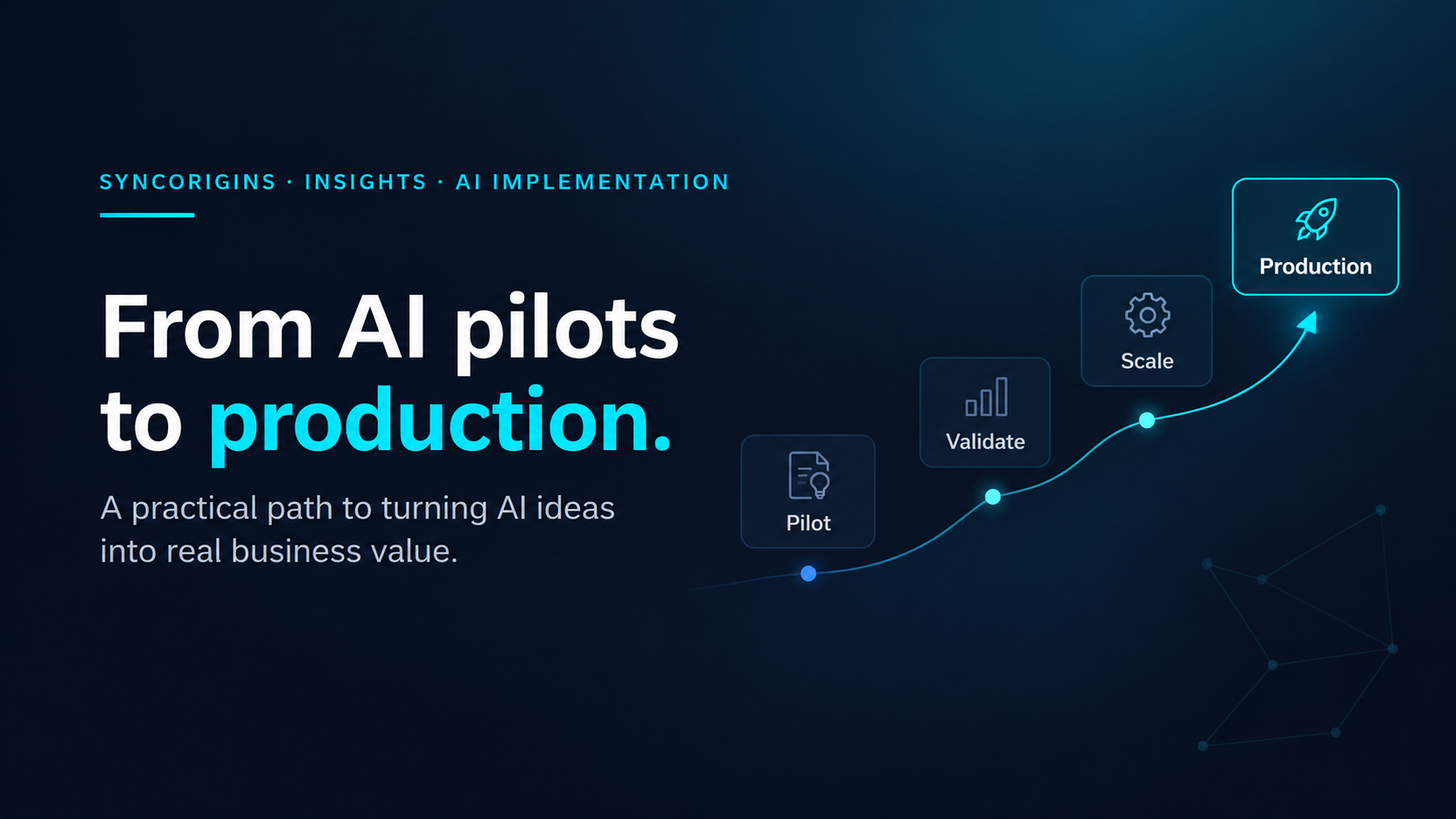
Most businesses have an AI pilot somewhere by now. A chatbot someone built over the weekend, a forecasting model the data team is proud of, a document-reading demo that impressed everyone in the leadership meeting. And a few months later, it's still a demo.
The usual ending. The pilot works well enough in a sandbox, but nobody can say who will run it, what it will cost at full volume, or how it fits the way the business actually operates. So it just sits there.
Getting past that point is the hard part of enterprise AI implementation, and it's mostly not about the model. It's about goals, data, ownership and people. Below we go through why pilots stall, what needs to be in place first, and the six steps we'd follow to get one live. We also cover when it makes sense to bring in AI implementation services instead of doing everything in-house.
Why AI Pilots Struggle to Reach Production
A pilot answers one question: can this work? Production asks a harder one: can this work every day, with messy real data, thousands of users, and someone to call when it breaks?
The numbers back that up. IDC research, as reported by CIO, found that 88% of AI proofs of concept never make it to full deployment. A much-quoted MIT report from 2025 painted a similar picture for generative AI pilots. Studies vary on the exact figures, but they all point the same way.
When you look at why, it's rarely the technology. Four things come up again and again.
The pilot never had a business goal. It was built to show what AI could do, so when the demo ends there's nothing to justify the next budget.
The setup doesn't survive real volume. Pipelines and integrations that cope fine with a hundred test records start to creak with a hundred thousand.
Governance and training get pushed to "after launch". By then the budget and the enthusiasm are usually gone.
And every team ran its own experiment on its own stack, so nothing can be reused or scaled across the business.
What Businesses Need Before Moving AI to Production
Before you set a production date, check that you have the basics. If a few of these are missing, the better move is to fix them first, not to run a bigger pilot.
You need a use case with an owner on the business side, someone who cares more about the result than about the technology. You need data that's accurate, accessible and cleared for this purpose. You need infrastructure that can take real workloads, with security and integrations already thought through. You need clear rules on who can use the system, what it may do on its own, and when a person steps in. And you need a plan for after launch, including who monitors it and who retrains it when results start to slip.
None of this is exciting. All of it is what separates the pilots that ship from the ones that don't.
How to Move AI From Pilot to Production
Here's the order we'd work in.
1. Define a Clear Business Outcome
Pick the problem before you pick the tool. Which decision should get better? Which process should get faster? Which cost should come down? Then put a number on it.
"Improve customer service" isn't a goal. "Cut average handling time by 20% in six months" is, because you can measure it and defend it when budget season comes around.
Get legal, compliance, IT and the business team in the room early. It's much cheaper to hear their objections in week one than in month six. This is also where you decide how complex the solution really needs to be. Answering questions from a document library is a very different build from an AI agent that plans and carries out multi-step work.
2. Assess Data and Infrastructure Readiness
A readiness check tells you whether your organisation can keep an AI system running, not just build one. Look at three things.
Data first. Is it clean, organised and properly governed, and can your pipelines handle production volume without someone fixing things by hand?
Then infrastructure. A slow response that nobody notices in a pilot becomes a real problem at thousands of requests an hour.
And people. Who owns the system once it's live? Who spots when results start drifting, and who decides to retrain?
Problems found here are cheap to fix. The same problems found at the go-live meeting are not.
3. Design the Pilot for Production
Most pilots ask whether the technology can do the task. A better pilot asks whether it can run reliably in your real environment.
That changes how you build it. Use real data, or a sample that includes the awkward edge cases. Build the integrations the live system will need. Add access controls and logging from day one. Test with realistic load.
Do this and the pipelines and monitoring you build carry straight into production instead of getting thrown away. Also write down every assumption you make along the way and test each one properly. The untested ones are what usually bite later.
4. Build Governance Into the AI System
Governance bolted on after launch turns into a box-ticking exercise that slows everything down without cutting much risk. It works when it's part of the design.
Decide who owns the model, how versions are tracked and what gets logged while you're still building. Set data access rules before the first integration goes live. Run compliance reviews alongside the technical work, not as a final gate nobody wants to open.
Keep people in the loop where the stakes are high. Spell out what the system may do by itself and when it has to hand over to a human. In regulated industries, make sure it can explain its answers to an auditor, because retrofitting that is painful.
5. Prepare for Monitoring and Continuous Improvement
Going live is when the real work starts. A production AI system needs a few things running in the background.
Automated pipelines for data, retraining, testing and deployment, so growth doesn't mean a matching growth in manual effort. Monitoring that covers both the technical side (speed, errors, uptime) and the business result you defined in step one, because a system can look perfectly healthy on a dashboard while the value it delivers quietly shrinks. And drift detection, because customers, markets and regulations change. If the data coming in moves away from what the model learned, quality drops without anyone noticing.
Review results monthly for the first six months, then quarterly. Each time, ask whether you're getting the business value you planned.
6. Drive User Adoption
A system people don't trust or use delivers nothing, however good the engineering is. Treat adoption as part of the project from the start.
Tell people plainly what the system does, what it doesn't, and where their judgement still matters. Train them properly so they know how to read outputs, when to override them, and how to report problems. And involve the teams whose daily work is changing, because they'll spot flaws long before a dashboard does.
Roll out in stages. Begin with a small group doing real work with oversight, then widen it based on results, not on a date someone put on a slide.
AI Implementation Services for Moving From Pilot to Production
Plenty of businesses have the idea and a working pilot, but not the spare engineers, data experience or delivery muscle to take it live. That's the gap AI implementation services fill.
At SyncOrigins, we work with businesses across the whole path, with delivery teams in India supporting clients in the US and UK. That can mean helping choose which use cases deserve to go to production, checking data and infrastructure readiness before work is scoped, building the pipelines and integrations behind AI solutions for business operations, setting up governance, monitoring and retraining, and providing dedicated engineers to keep improving the system after launch.
The idea is simple. Your team stays focused on the business result, and we handle the engineering and delivery work that makes AI deployment for businesses dependable.
Conclusion
Getting AI from pilot to production is less about smarter technology and more about preparation. Start with an outcome you can measure. Be honest about your data and infrastructure. Build the pilot as a rehearsal for production. Design governance in from the beginning, plan for life after launch, and bring your users along.
Do that, and enterprise AI implementation stops being a string of demos and starts producing results. If you've got a pilot that's stuck, or a use case you want to take live, get in touch with SyncOrigins and we'll help you map the path.
Sources:
Deloitte, "From AI pilots to production: Getting the tech right", Straive, "How to Move from AI Pilot to Production: A Step-by-Step Guide", IDC research as reported by CIO.