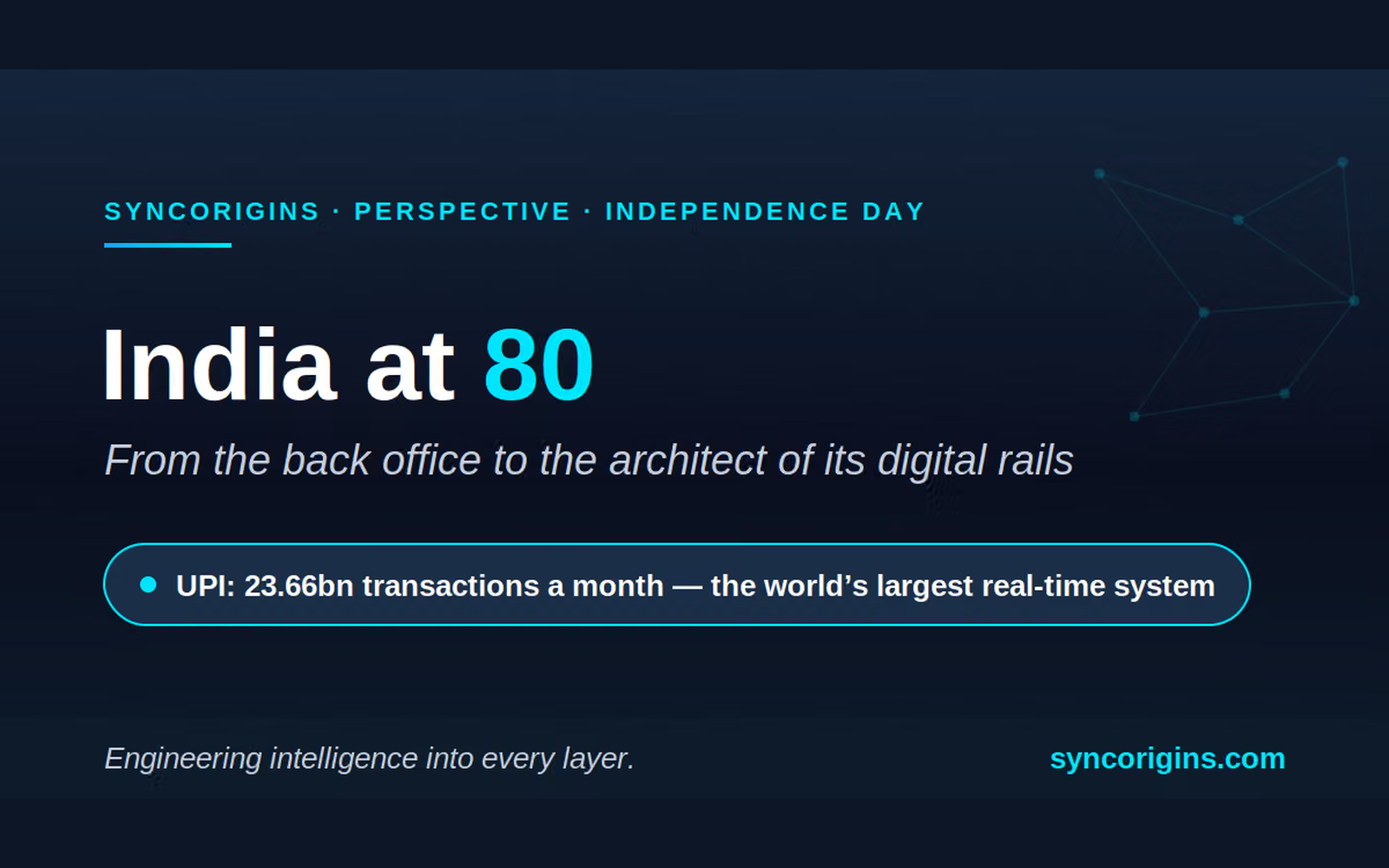

Every second of every day, somewhere in India, close to nine thousand payments move through a system called UPI. Not in a data centre in Silicon Valley — on a shopkeeper’s ₹2,000 phone in a tier-3 town, settling a ₹40 cup of tea in the time it takes to glance up. In July 2026 that system processed 23.66 billion transactions in a single month. The International Monetary Fund calls it the largest real-time payments network on earth, and it now carries close to half of all real-time digital payments made anywhere in the world.
None of that was imported. India built it.
That single fact should retire a lazy story that has trailed the country for forty years: that India’s role in technology is to be the world’s back office — somewhere to send work to be done at scale, out of sight, and cheaply. On the 80th Independence Day, that story is not just unflattering. It is wrong.
What India actually built
Consider what exists. UPI turned real-time payments into a public utility, open to every bank and every app, and in doing so pulled hundreds of millions of people into the formal economy. Aadhaar gave more than a billion people a verifiable digital identity. Around them sit further layers — consent-based data sharing, digital documents, e-signatures — and together they form what the world now calls Digital Public Infrastructure, or DPI: open, interoperable rails that anyone can build on, running at population scale.
The striking part is not that it works at home. It is that the rest of the world has started to copy it. Through 2026 India pitched DPI as a template other nations can adopt, and moved to take the playbook to countries across the Global South. The shorthand has quietly inverted. For a generation of technologists, India was where you sent the blueprint to be executed. Increasingly, India is where the blueprint is drawn.
For forty years the world sent India its blueprints to execute. The quiet achievement of the last decade is that India started drawing them.
What actually changed
The change is not that India learned to write software — it always could. The change is architectural. Building UPI or Aadhaar is not a coding task you can rent by the hour. It is a systems-engineering problem: designing something open, secure, interoperable and reliable enough to carry a billion people, and getting the incentives right so an entire market builds on top of it. That is a different discipline from executing someone else’s specification, and it is the discipline India has spent a decade proving it owns.
That distinction — between executing a blueprint and engineering the thing itself — is the whole story of the next eighty years.
The journey ahead
Because the same test is arriving again, in AI — and India’s answer is characteristically its own. Rather than trying to out-spend the frontier labs, it is treating AI the way it treated payments: as public infrastructure. The IndiaAI Mission, a programme of around ₹10,372 crore (roughly $1.25bn), is pooling subsidised GPU compute — tens of thousands of chips today, on the way to a stated target of 100,000 by the end of 2026 — while funding open, Indian-language foundation models and building shared datasets and skilling. In February 2026 India hosted a global AI summit and made the pitch plainly: build AI like DPI, then help others adopt it too.
Whether every target lands exactly on schedule is beside the point. The direction is what matters, and it is deliberate: not to be the place where the world’s AI is quietly operated, but to be one of the places where it is designed — in the open, for more than just the richest markets.
The India we build from
This is the ground SyncOrigins works from.
We describe ourselves as engineering-led, and we mean the phrase precisely because of the heritage behind it: a country that learned, in the hardest possible way, the difference between doing the work and owning the architecture.
We serve clients across the UK, the US, Europe and the Middle East not as a set of hands pointed at a backlog, but as engineers who design the system, own the outcome and stand behind it.
Eighty years ago, India won the right to determine its own future.
The digital chapter of that story is being written now - and for the first time, India is not translating someone else’s vision of it. It is authoring its own.
Happy 80th Independence Day
There has never been a better time to build from here.