Businesses generate valuable data every day, from sales and inventory to finance, procurement, and customer operations. Yet, having access to large amounts of information does not always translate into better decisions.
When data is scattered across departments and disconnected applications, businesses often struggle to understand their overall performance.
Enterprise Resource Planning (ERP) systems help bridge this gap by connecting business processes, improving data accessibility, and providing more reliable information for decision-making.
Let's explore how ERP systems improve data visibility and help businesses make smarter operational and strategic decisions.
Why Data Visibility Matters for Business Decision-Making
Good decisions depend on accurate and timely information.
Consider a manufacturing company managing customer orders, production schedules, inventory, and supplier deliveries. If these activities are tracked separately, understanding whether an order can be fulfilled on time becomes difficult.
With better data visibility, teams can identify material shortages, monitor production progress, and assess delivery commitments using connected information.
This helps businesses respond faster, improve coordination, and identify potential issues before they affect operations.
The real value of data visibility is not having more information. It is having the right information when decisions need to be made.
Common Data Challenges Without an Integrated ERP System
Businesses relying on disconnected applications and spreadsheets often face several challenges:
- Data silos: Information remains isolated across departments, making collaboration difficult.
- Manual reporting: Teams spend valuable time consolidating spreadsheets and verifying information.
- Inconsistent records: Different systems may contain conflicting customer, inventory, or financial data.
- Limited operational visibility: Delays, shortages, and rising costs may go unnoticed until they become serious.
- Unreliable forecasting: Incomplete historical information makes planning and budgeting more difficult.
An integrated ERP system helps address these issues by connecting business functions and improving the consistency and accessibility of information.
How ERP Systems Improve Data Visibility
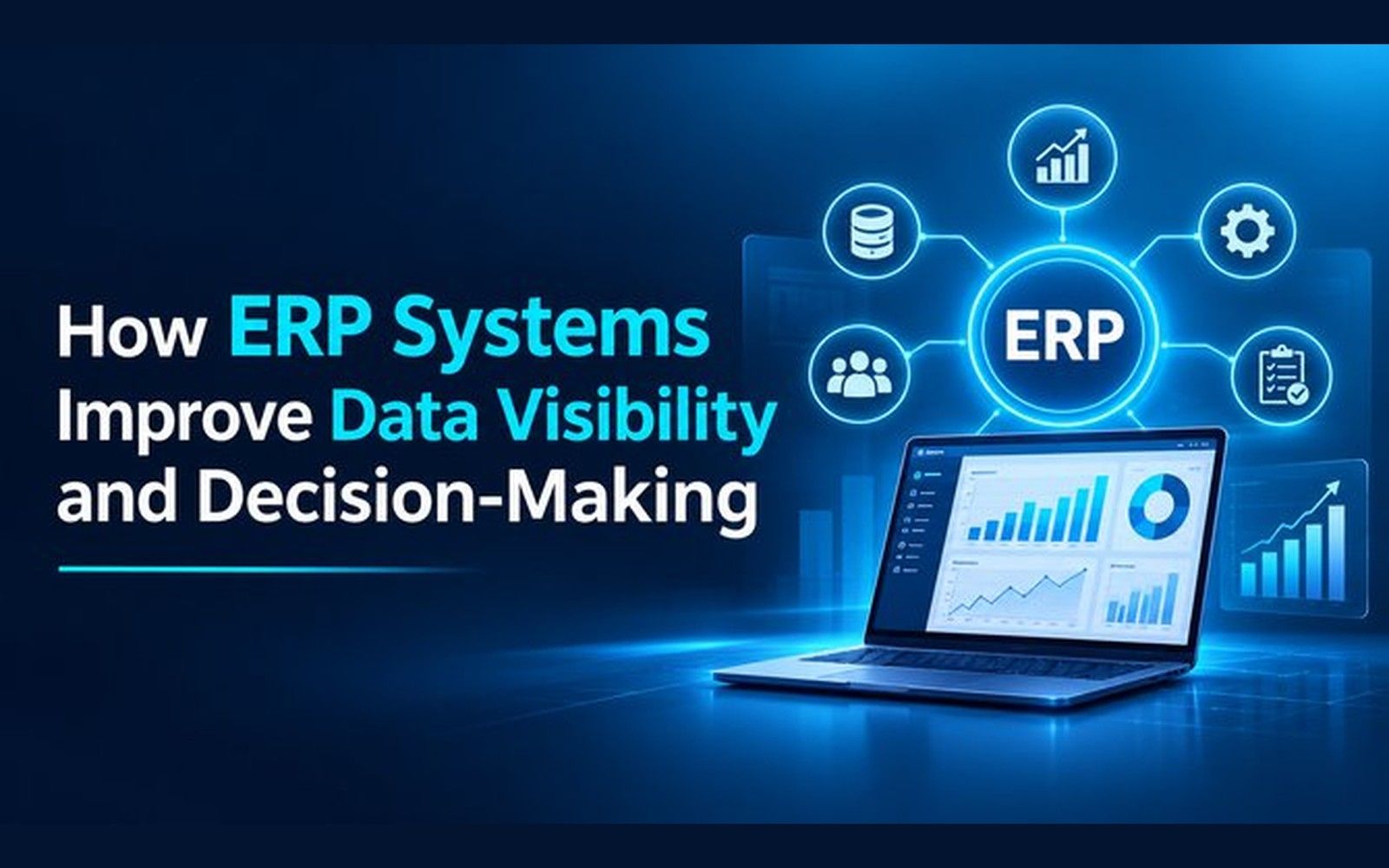
Modern ERP platforms such as Microsoft Dynamics 365, SAP, and Oracle bring together critical business processes, including finance, procurement, inventory, manufacturing, and sales.
Through ERP transformation, businesses can improve system integration, streamline workflows, and create a more connected view of business performance.
Here are five ways ERP systems support better decision-making.
1. ERP Data Supports Faster Decisions
Imagine a distributor receiving a large customer order.
Before confirming delivery, the team needs to check available inventory, existing commitments, and incoming supplier shipments.
Without connected systems, this information may require multiple emails, spreadsheets, and manual checks.
An ERP system allows relevant teams to access these details through integrated records, helping them evaluate order fulfilment more efficiently.
When inventory, procurement, sales, and finance information is connected, employees can make decisions based on a more complete understanding of current business conditions.
Business benefit: Faster access to reliable ERP data reduces decision delays and improves coordination across departments.
2. ERP Analytics Turn Business Data Into Actionable Insights
ERP analytics help businesses understand patterns behind everyday transactions.
For example, a retailer may discover that its best-selling product is not necessarily its most profitable one.
By analysing sales, inventory costs, and margins together, management can identify which products contribute more to profitability and adjust purchasing or pricing strategies accordingly.
With effective data analytics services, businesses can further improve how they collect, process, analyse, and interpret information from different operational systems.
ERP analytics can help organisations monitor:
- Revenue and profit margins.
- Inventory turnover and stock movement.
- Procurement costs and supplier performance.
- Production efficiency and operational expenses.
- Sales trends and customer order patterns.
These insights help decision-makers move beyond reviewing historical reports and understand what drives business performance.
Business benefit: ERP analytics help organisations identify trends, evaluate performance, and make informed decisions using business data.
3. ERP Improves Financial and Operational Decisions
Financial and operational decisions are closely connected.
For instance, purchasing additional inventory may prevent stock shortages but also increase storage costs and tie up working capital.
An integrated ERP system helps procurement and finance teams evaluate these trade-offs using shared information.
It can connect purchase orders, inventory movements, production costs, invoices, and payments, providing a clearer understanding of operational and financial performance.
Businesses can use this connected information to evaluate purchasing decisions, manage expenses, allocate resources, and understand the financial impact of operational changes.
Integrating ERP platforms with reporting tools and other enterprise applications can further improve access to consistent information across departments.
Business benefit: Better alignment between finance and operations supports cost control, resource allocation, and profitability decisions.
4. ERP Supports Forecasting, Planning, and Risk Management
ERP systems provide historical and current business data that can support forecasting and planning.
A retailer preparing for seasonal demand can analyse previous sales, current inventory, and supplier lead times to estimate future purchasing requirements.
Similarly, finance teams can use ERP information to compare budgets against actual expenses and monitor cash flow.
ERP-supported planning helps businesses:
- Forecast demand and inventory requirements.
- Plan procurement and production activities.
- Monitor budgets and financial performance.
- Identify supply chain and operational risks.
- Evaluate resource requirements and business priorities.
The reliability of these forecasts depends on data quality, system integration, and appropriate planning assumptions. Incomplete or inaccurate information can still lead to poor decisions.
Businesses can strengthen this foundation through effective data engineering, which helps establish reliable data pipelines and improve the accessibility and consistency of business information.
Business benefit: Connected ERP data helps organisations plan more effectively and respond proactively to potential risks.
ERP Transformation Services for Better Decision-Making
Implementing an ERP system is only part of the journey. Businesses also need reliable data, connected applications, and well-defined processes to realise its full value.
An ERP platform may contain valuable information, but disconnected applications, outdated processes, and inconsistent data can limit its usefulness.
Effective ERP transformation typically focuses on the following areas.
ERP Modernisation
Upgrading existing ERP environments can help businesses improve system performance, streamline workflows, and support evolving operational requirements.
Application Integration
Connecting ERP platforms with CRM, cloud platforms, and other enterprise applications helps reduce information gaps and improve data sharing across business functions.
Data Engineering
Reliable data pipelines and integration processes help businesses consolidate information from multiple systems and make it available for reporting and analysis.
Reporting and Analytics
Dashboards and business intelligence solutions help organisations monitor key performance indicators, identify trends, and evaluate business outcomes.
AI Readiness
Preparing enterprise data for intelligent automation and AI-powered applications requires appropriate data integration, governance, security, and quality controls.
At SyncOrigins, we help organisations modernise and integrate ERP environments, with capabilities across Microsoft Dynamics 365, SAP, Oracle, and enterprise data engineering.
Our focus is on helping businesses build connected systems that improve operational visibility and support informed decision-making.
Conclusion
ERP systems do more than connect business applications. They help organisations understand how different parts of their business work together.
From improving operational visibility and financial reporting to supporting analytics and forecasting, an integrated ERP environment provides a stronger foundation for informed decisions.
However, the greatest value comes when reliable data, connected processes, and the right technology work together.
At SyncOrigins, we help businesses modernise ERP systems, strengthen integrations, and build data foundations that support more efficient, data-driven operations.