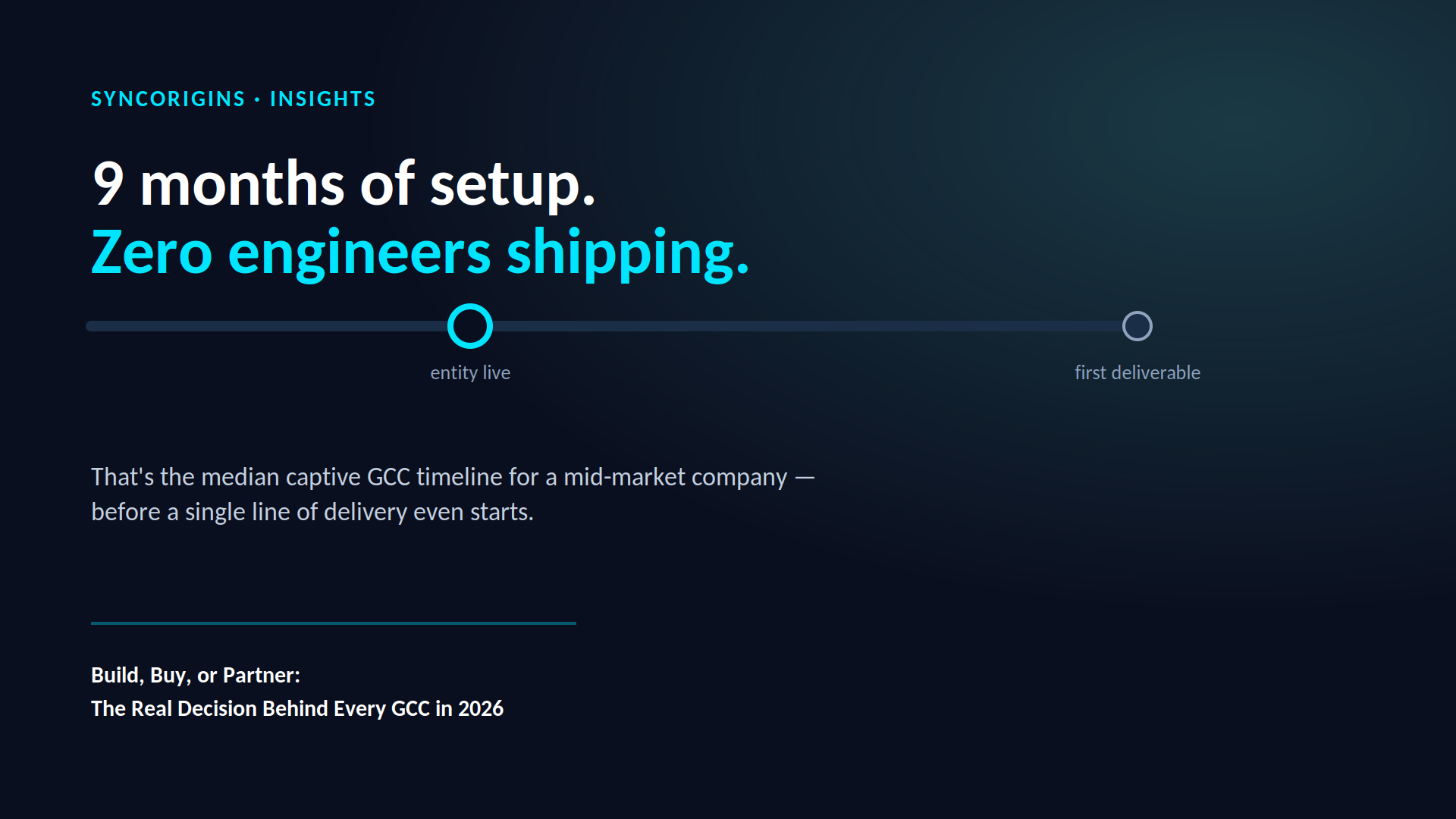

In March, a VP of Engineering at a $600 million US retail brand got board approval to open a captive Global Capability Centre in Bangalore. The pitch was simple: cut delivery cost, own the IP, build a bench that compounds over time. By September, six months later, she had a signed lease, a freshly registered Indian entity, three statutory compliance filings still moving through the system, a payroll provider onboarded, and zero engineers writing a line of production code.
The board had approved the GCC as a cost decision. Nobody had costed the fact that standing up the legal, HR, banking, and IT scaffolding around a wholly owned Indian entity takes most of a year before delivery even starts — and that the fixed overhead of that entity sits on the books the entire time, whether or not a single deliverable has shipped.
She isn't unusual. She's the median outcome for a mid-market company that reaches for the captive playbook written for companies ten times its size.
| ● | 2,117 GCCs now operate across 3,728 individual units in India, up 32% since FY2021 (nasscom–Zinnov India GCC Landscape Report 2026). |
|---|---|
| ● | Combined GCC revenue reached $98.4 billion in FY2026, up from $64.6 billion in FY2024 — a five-year compound growth rate of roughly 9.9%. |
| ● | 2.36 million people now work inside Indian GCCs, on a trajectory to cross 2.5 million by 2030. |
| ● | 583 of those centres are mid-market operations and a further 504 are PE-backed — captive and partner-led delivery has moved well past the Forbes Global 2000 companies that used to define the category. |
| ● | GCCs accounted for roughly 38% of office leasing across India's top seven cities in 2025, according to JLL — a scale of commitment most mid-market boards underestimate going in. |
| ● | Captive GCC — a wholly owned subsidiary of the parent company. Full IP ownership, full operational control, and the full legal, tax, and compliance burden on your own books from day one. |
|---|---|
| ● | Outsourcing / BPO — a third-party vendor delivers from shared infrastructure serving multiple clients at once. Fast to start, but you own no IP, no dedicated bench, and no institutional knowledge that compounds over time. |
| ● | Managed GCC / Build-Operate-Transfer (BOT) — a partner stands up and runs the centre under your brand and reporting lines, with ownership transferring to you on a schedule agreed upfront. |
| ● | Staff augmentation — the fastest lever of all, well suited to a single sprint or a specific skills gap, but it builds no entity, no IP position, and no capability that outlives the engagement. |
The advice you're reading was written for someone else's balance sheet
Almost everything published about GCC strategy is written for the Forbes Global 2000 — companies with in-house treasury and legal teams across three jurisdictions and a five-year runway over which to amortise setup cost. That is not the $300 million to $3 billion mid-market.
For that segment, leading with a captive-first strategy is usually the wrong first move — not because the captive model is flawed, but because the entity-formation timeline (typically six to nine months for registration, banking, and statutory compliance in India) and the fixed overhead both land before a single deliverable ships. A Build-Operate-Transfer model gets the same delivery capability — the same engineers, the same output, the same reporting cadence — live in as little as 90 days, with none of that fixed cost sitting on your balance sheet before the model has proven itself.
You keep the option to convert to a fully owned entity once the centre has earned its place in the budget, rather than betting the budget on an entity you haven't tested yet.
The five decisions that actually determine the outcome
1. Define the mandate before the headcount. Decide precisely what the centre exists to do — engineering delivery, data platform ownership, 24/7 production support — before deciding how many people it needs. Headcount-first plans drift into generic staffing with no clear line of accountability.
2. Stress-test build vs. partner vs. BOT against your own runway, not against a case study from a company ten times your size. Model the fixed cost of a captive entity against 18 months of delivery, not against a hypothetical year five where the economics finally work.
3. Pick the city for the talent pool, not the logo wall. Bangalore and Hyderabad dominate the headline coverage, but Pune, Chennai, and Ahmedabad now carry meaningful mid-market GCC density at a materially lower cost base, with less competition for the same senior talent.
4. Start with a pilot pod of eight to twelve people, not a full org chart. Prove the delivery model, the reporting rhythm, and the quality bar before committing to a lease, a larger headcount plan, or a permanent entity.
5. Write the transfer clause before you write the offer letters. If a BOT model is on the table, the IP assignment, the employee-transfer mechanism, and the valuation formula for the eventual handover need to exist in writing before day one — not get renegotiated once the centre is delivering and the leverage has shifted.
What doesn't change, whichever model you choose
None of this makes a GCC — captive, BOT, or otherwise — a free lunch. Every model still needs real governance, a genuine reporting line into the part of the business it serves, and leadership willing to treat the centre as a capability rather than a place to hide headcount off the parent company's cost centre. What changes with the right model is when you take on the fixed overhead, and how much of it you carry before the centre has proven it's worth the commitment you're about to make.
Frequently asked questions
What's the actual difference between a GCC and outsourcing?
A GCC is a wholly owned or partner-operated extension of your own company — you own the IP, the reporting lines, and, eventually, the entity itself. An outsourcing vendor delivers from shared infrastructure across multiple clients and owns none of that on your behalf.
How long does it actually take to set up a GCC in India?
A fully captive entity typically takes six to nine months for registration, banking, and statutory compliance before delivery even begins. A partner-led (BOT) model can have a working pod delivering in 60 to 90 days, with formal entity formation running in parallel rather than blocking the start.
Do we need a fully owned entity to start?
No. A Build-Operate-Transfer model lets a partner run the centre under your brand from day one, with ownership transferring to you on a schedule you agree upfront — giving you the delivery capability without carrying the entity risk immediately.
What's the minimum viable team size for a GCC?
Most successful mid-market centres start with an eight-to-twelve-person pilot pod focused on a single, clearly defined mandate, then scale headcount once the delivery model and reporting cadence have been proven out.
Can a partner-led GCC convert into a fully owned entity later?
Yes — that conversion is the entire point of a BOT structure. The IP assignment, employee-transfer terms, and valuation mechanism should be agreed in the original contract, not negotiated after the centre is already delivering and the leverage has shifted.