Most businesses today understand why sustainability reporting matters. The difficult part is often figuring out where all the information comes from and whether it's accurate.
Think about a company with multiple offices, manufacturing facilities, and suppliers. Energy consumption figures might come from the operations team, employee information from HR, and supplier-related data from procurement. Each team has its own systems, spreadsheets, and ways of maintaining records.
When it's time to prepare an ESG report, bringing all this information together can become a challenge.
And that's where businesses often realize that ESG reporting is as much a data management challenge as it is a sustainability initiative.
What Is ESG Data Management?
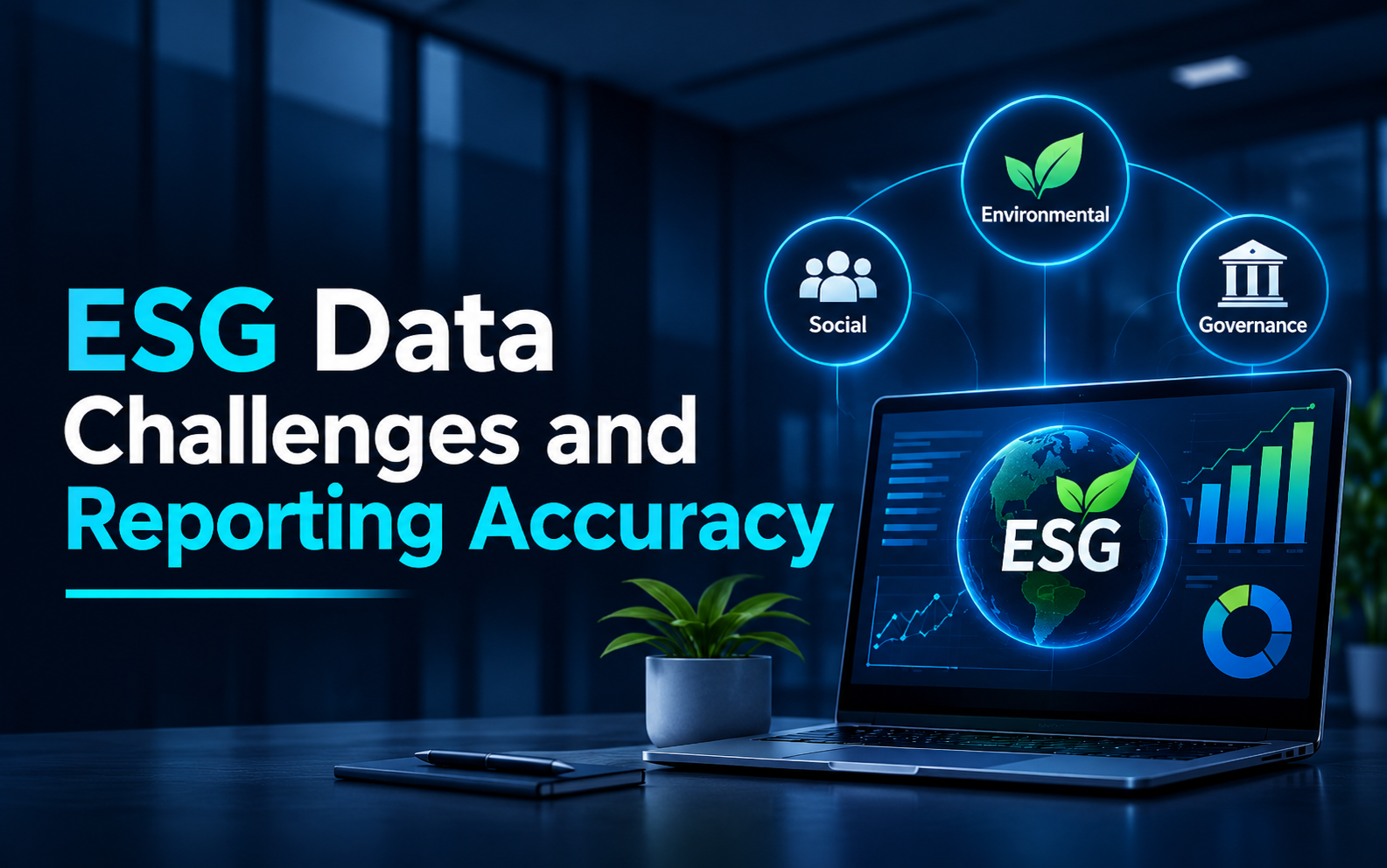
ESG stands for Environmental, Social, and Governance. It covers how a business manages its environmental impact, people-related responsibilities, and corporate practices.
ESG data management is simply the process of collecting, organizing, checking, and maintaining this information so businesses can report on it with confidence.
This typically includes:
- Environmental: Energy consumption, carbon emissions, water usage, and waste.
- Social: Employee safety, workplace practices, diversity, and employee well-being.
- Governance: Compliance, business ethics, internal controls, and risk management.
The goal isn't just to produce an annual sustainability report. It's to make sure the information behind that report is reliable and useful.
Common ESG Data Management Challenges
Many ESG reporting challenges come from the same data problems businesses already experience in their day-to-day operations.
1. Fragmented Data Across Business Systems
Imagine a manufacturing company with five production facilities.
Each facility tracks its electricity consumption separately. The finance team maintains utility expenses, while procurement manages supplier information in another system.
Now imagine trying to bring all these records together for a single report.
When information is scattered across departments and systems, teams spend more time collecting and reconciling data than actually understanding it.
2. Inconsistent Metrics and Reporting Methods
Even when businesses have the required information, it isn't always recorded consistently.
One department might track energy consumption monthly, while another reports quarterly. Some locations may use different measurement units or calculation methods.
These differences might seem small, but they can create confusion when businesses compare performance across locations or prepare consolidated reports.
3. Manual Data Entry and Limited Validation
Spreadsheets are still widely used for ESG reporting, and there's nothing inherently wrong with that.
The problem begins when multiple people manually copy information between spreadsheets, emails, and business systems.
A missed entry, an incorrect formula, or an outdated file can affect the final numbers.
Without proper checks, these mistakes may only become visible when someone reviews the report.
4. Limited Supplier and Scope 3 Emissions Data
A company may have reasonable visibility into its own operations, but understanding the environmental impact of its wider supply chain is more difficult.
Scope 3 emissions include indirect emissions across the value chain, such as those associated with purchased materials, transportation, and product use ESG and carbon credits also play an important role in emissions reporting.
Not every supplier has the systems or resources to provide detailed emissions information.
This often leaves businesses working with incomplete information or estimates, which need to be clearly documented.
5. Weak Data Ownership and Audit Trails
One question can reveal a lot about the quality of ESG data:
Who is responsible for this number, and where did it come from?
If teams struggle to answer, there may be gaps in data ownership or documentation.
Without clear responsibilities and proper records, verifying information becomes difficult, especially during audits or external reviews.
How Businesses Can Improve ESG Reporting Accuracy
The good news is that businesses don't necessarily need to replace their existing systems to improve ESG reporting.
In many cases, improving how information is collected, connected, and validated can make a meaningful difference.
1. Establish Clear ESG Data Governance
Start by identifying who owns each type of ESG information.
For example, HR may be responsible for workforce data, operations for energy consumption, and procurement for supplier-related information.
Each team should understand what information it needs to provide, how frequently it should be updated, and who reviews it.
Clear ownership helps prevent confusion and makes reporting more manageable.
2. Standardize Metrics and Validation Rules
Businesses should agree on common definitions, measurement units, and reporting periods.
If multiple facilities report electricity consumption, they should follow the same measurement and reporting approach.
Simple validation checks can also help identify missing information, unusual changes, or duplicate entries before they affect the final report.
Reporting metrics should be aligned with whichever sustainability standards apply to the organization.
3. Integrate Data From Existing Business Systems
A lot of the information required for ESG reporting may already exist within the business.
The challenge is that it sits in different places.
Connecting ERP, finance, HR, procurement, and operational systems can make information easier to access and reduce the need for repeated manual data collection.
Instead of asking every department to prepare separate reports, businesses can work towards a more connected view of their ESG information.
4. Automate ESG Data Collection and Reporting
Once data sources are connected, businesses can look at automating repetitive activities.
For example, energy consumption figures could be collected from operational systems, checked against predefined rules, and made available through reporting dashboards.
Automation can help reduce manual effort and identify potential errors earlier.
Of course, automated processes still need reliable source data, appropriate calculation methods, and human review.
5. Maintain Audit-Ready Records
Businesses should be able to explain how reported ESG figures were calculated.
This means keeping records of where information originated, which calculation methods were used, and who reviewed or approved the results.
Having this information readily available makes reporting more transparent and reduces the effort involved in responding to audit questions.
How Integrated Data Supports Sustainability Reporting
Let's take a practical example.
A manufacturer wants to understand how energy consumption varies across its production facilities.
Today, each facility sends monthly spreadsheets to the head office. Someone then combines the files, checks for missing information, and prepares a consolidated report.
By connecting energy and operational data into a shared reporting environment, the company could spend less time gathering numbers and more time understanding them.
It could become easier to:
- Compare energy consumption across facilities.
- Identify locations with unusually high resource usage.
- Track sustainability performance over time.
- Spot missing or inconsistent information earlier.
- Prepare reports without repeatedly collecting the same data.
More importantly, the information becomes useful beyond the reporting cycle.
For instance, identifying a facility with unusually high energy consumption could prompt an operational review and potentially uncover opportunities to improve efficiency.
That's where good data management starts creating value beyond compliance.
Conclusion: Build a More Reliable ESG Data Management Process
ESG reporting doesn't have to begin with a large technology investment.
For many businesses, the first step is understanding what information they already have, where it sits, and how reliable it is.
Once that foundation is clear, improving data ownership, connecting systems, and introducing automation becomes much more practical.
At SyncOrigins, we work with businesses to simplify complex data environments through Data Engineering, System Integration, and Analytics. These capabilities can help organizations build a more dependable foundation for reporting and decision-making.
Because ultimately, better sustainability reporting starts with data businesses can trust.